
Ding Yiteng is one of the most popular young directors and actors in China. He is a recipient of the national «Outstanding New Chinese Director» award. In his work, he blends Chinese tradition with contemporary European theater. Ding Yiteng’s productions have been featured at numerous international festivals in France, Denmark, Poland, Romania, Brazil, and China. In recent years, the director has also been working in Russia: at the Theatre of Nations, he staged the play «I Did Not Kill My Husband,» based on the satirical novel «I Am Not Pan Jinlian» by Liu Zhenyun, one of China’s most popular authors; and at the Stary Dom Theatre in Novosibirsk, he adapted another of Liu’s books, «One Day Is Worth Three Autumns.» He is now premiering a new production at the Alexandrinsky Theatre in St. Petersburg, based on the novel «Life and Death Are Wearing Me Out» by Nobel Prize laureate Mo Yan.
On the eve of the premiere, we spoke with the director about Chinese and Russian theatrical traditions, the dialogue of cultures, and the «challenges of translation.»
Translated with AI assistance
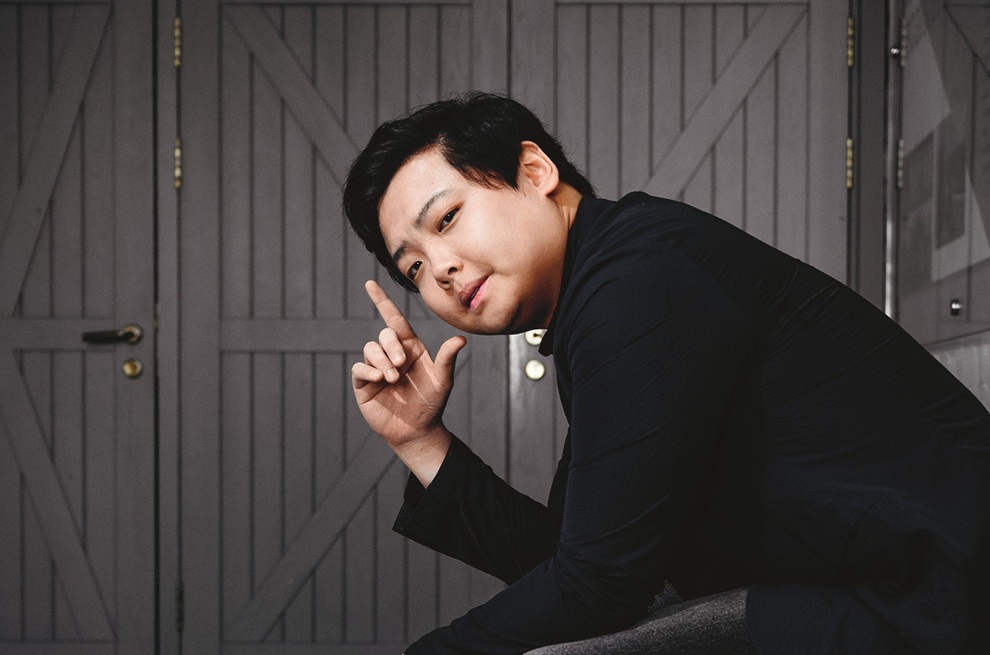
Interviewer: Marina Shimadina
Filming location: Theatre of Nations
Today, Russia and China are actively developing political and economic cooperation. In your opinion, what role do cultural ties play in the dialogue between the two countries?
If we are talking about a dialogue between two countries, business and economics alone are not enough to build strong relationships. To understand how your partners think, you need to engage in culture together—to create things, to stage plays. Only on this foundation can true friendship be built. Politics and economics are important, but they cannot help you understand another country the way culture can. When Yevgeny Mironov watched my play «I Didn’t Kill My Husband» at the Theatre of Nations, he laughed heartily and shattered his stereotype that a Chinese person couldn’t stage such a funny production. Culture is essential for breaking down stereotypes like these.
Culture, on the one hand, helps us understand each other, but on the other, it most vividly reveals differences in mentality. What peculiarities of the Russian character have you encountered? What was the most difficult to adjust to?
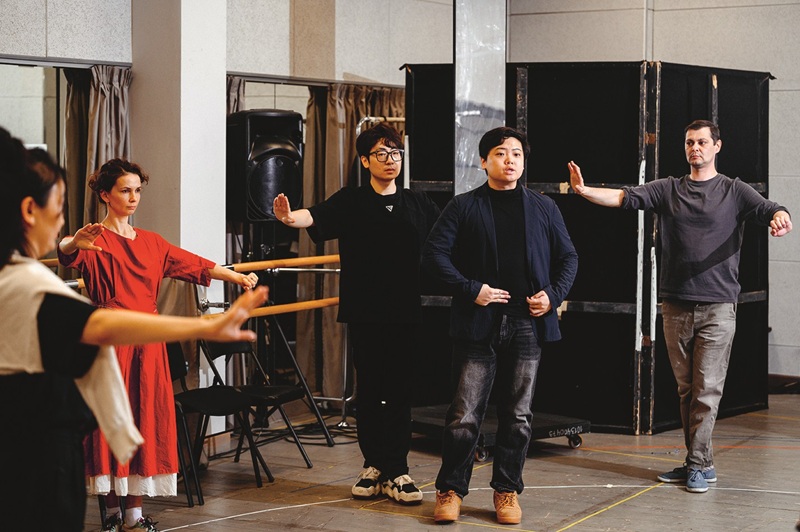
I can’t say there were any particular difficulties or peculiarities that posed a challenge. On the contrary, I constantly admire Russian performers—they are incredibly tenacious. We train every day—it’s demanding; they may get tired, even cry, but they keep working nonetheless. However, Russian artists tend to think and analyze more; they need to intellectually process and «digest» everything. Chinese stage traditions, by contrast, are more centered on movement. So I tell the Russian actors: try to approach your work not from the head, but from the body, from movement—seek the character’s essence there.
Do the artists argue with you or suggest their own ideas?
As a director, I love creating a creative space for actors where they can freely create and experiment. I give them a great deal of freedom. And at the Theatre of Nations, I met incredible performers—Maria Smolnikova and Elena Morozova—who came up with so many ideas, created nonstop, and constantly invented new things. At the Stary Dom Theatre in Novosibirsk, Timofey Mamlin, who played one of the lead roles, and I often argued, but even through those debates something new was born. And at the Alexandrinsky Theatre, there are also experienced actors who themselves suggest what could be presented on stage; I learn a lot from them.

Are Chinese artists equally proactive, or are they more obedient to the director?
The artists I work with are also creative, proactive, and enjoy coming up with their own ideas. I’m not an authoritarian director who dictates from the very beginning: «Do it only this way, listen to me.» But on the final day, of course, I can take matters into my own hands and do things my way.
What else surprised you, perhaps?
I’ve also noticed that Russian theaters treat their day off with great reverence: we have our rightful Monday, and please, don’t touch it. In every city where I’ve worked, nothing can be done at the theater on Mondays—everyone is resting.

Do Chinese theaters have no days off?
We have very few days off. Actors need to study extensively, which takes a great deal of time—there is simply no time for rest. And when children train in Peking Opera, they have no days off at all for seven years, with classes every single day.
How is theater education structured in China? Are traditional performing arts and modern theater taught separately?
We have two branches of education: the first focuses on traditional Chinese theater, singing, and dance, while the second is modern theater, where the training system is oriented toward the Soviet school. In other words, these are two completely different directions, but in my productions I strive to unite the East and the West—that is my method.
Where did you study European theatre?
I completed my master’s degree in England and later worked in Denmark. My teacher was the Italian director Eugenio Barba—a student of Jerzy Grotowski (a Polish director, theatre theorist, pedagogue, creator of an acting method, and one of the leading reformers of 20th-century theatre.—Ed. note)—so I sometimes refer to myself as his artistic grandson.
Is Russia Europe to you, or is it closer to the East?
For us Chinese, Russia is the most important country in terms of theatre arts—Stanislavski, Meyerhold, Vakhtangov, and contemporary directors such as Tuminas, Butusov, Krymov, and Fokin. We know them well and hold them in the highest esteem. The Alexandrinsky Theatre has toured China, and the productions staged by its artistic director, Valery Fokin, are immensely popular here. I have been familiar with the name Fokin since my youth—Eugenio Barba often mentioned him, as they both took part in the Theatre Olympics together. I had always dreamed of seeing this director’s work, but I never imagined that Fokin would one day see mine.
Once, during a run-through of the play “I Didn’t Kill My Husband,” I noticed an elderly man sitting in the audience who laughed throughout the entire performance. And when, after the show, Evgeny Mironov brought this gentleman over to me and introduced us, it turned out to be Fokin himself. He congratulated me on the premiere, said he had enjoyed it very much, and expressed his hope to invite me to work at the Alexandrinsky Theatre. And that is exactly what happened.
Over the past two decades, Russia has frequently invited foreign directors to stage productions—initially from Europe, and now from China and Japan. Is there a similar tradition of inviting foreign directors in Chinese theaters?
Yes, we frequently invite foreign directors, including those from Russia. Rimas Tuminas has also staged a production with us. The more Chinese directors are invited to Russia, the more Russian directors we invite to China. It is a great honor for us, and I personally strive to foster these connections. I now have my own festival in Nanjing, near Shanghai, and I would like to invite as many Russian theaters as possible to participate. What makes this festival unique is that it will be held in a large hotel. This is currently the first festival of its kind in China. I am delighted that there are now many talented directors of my generation in Russia—Nikita Kobelev, Anton Fedorov—and I would love to invite them to my festival as well.
Which Russian authors do you like? And which of them are popular in China?
I have a great love for Bulgakov. In one reality show in China, I staged his «Heart of a Dog.» And at my festival, there will be an excerpt from «The Master and Margarita» featuring Woland’s Ball. Of course, I also admire Pushkin, but he is a challenging author for us. His most famous work in China is «Eugene Onegin.» I hope that one day I will be able to stage it.
I know that in Moscow you read «The Master and Margarita» at Patriarch’s Ponds. Has a similar «genius loci» emerged for you in St. Petersburg?
The other day, I was wandering through the city with no particular destination in mind when, at one point, I looked up and saw a statue gazing right at me. It said: “Hello, it’s me—Dostoevsky. Welcome to St. Petersburg! I hope you’ll stage something from my works.”
Are there any plans to stage something from the Russian classics here?
I would love to stage Gogol’s «The Government Inspector,» Bulgakov’s «The Fatal Eggs,» Chekhov’s «Three Sisters,» and adapt the film «Office Romance» for the stage. I think about this often, and we discuss such ideas with various theaters—perhaps something will come of it. Yevgeny Mironov remarked that since the first production has been such a success, perhaps the second one should be based on Russian material.
Now, another Chinese director, Mou Sen, will stage Sholokhov’s «And Quiet Flows the Don» at the Theatre of Nations.
This is a very challenging work; I wouldn’t dare to stage something like this.
As you introduce Russian audiences to Chinese literature and stage Nobel Prize winner Mo Yan’s novel “Life and Death Are Wearing Me Out” at the Alexandrinsky Theatre, what drew you to this material?
This story fits perfectly with the style of magical realism in which I usually work. The magical element lies in the fact that our main character is continually reborn as six different animals. The realism, meanwhile, stems from the lives of three generations of a single family throughout the second half of the 20th century. Through this narrative, audiences will be able to witness the societal transformations that took place in China over a span of 50 years. Yet it is less about politics and more about relationships, obsession, and attachment—which is why the protagonist keeps returning to this world, to the place where he once lived, to observe how it has changed.
In the Theatre of Nations production, a giant inverted wok became the centerpiece of the scenographic design. What visual metaphors might be at play here?
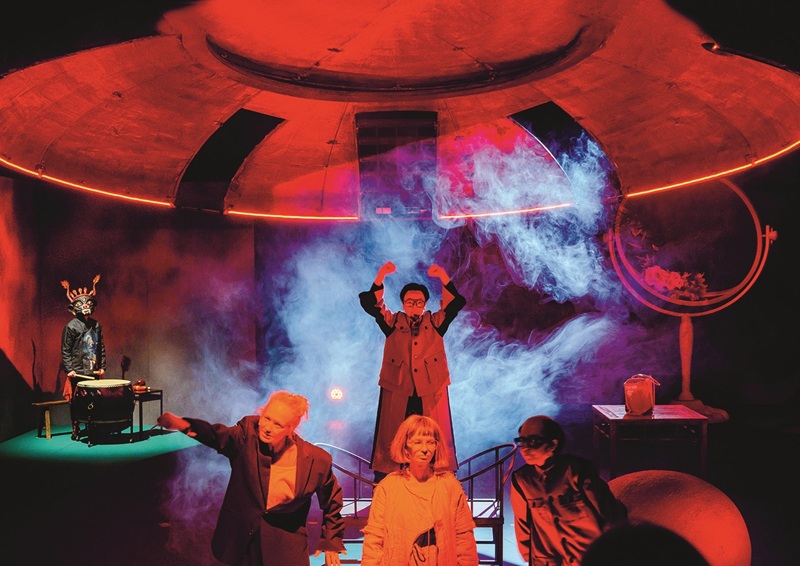
The novel is based on the Buddhist concept of rebirth, which is also reflected in the scenography. We will feature a Wheel of Samsara as a symbol of this eternal karma. However, we have approached this not from a strictly traditional perspective, but through a modern conceptual lens.
Is the production designer of the play also from China?
Yes, the artist and composer are also Chinese, and we also have a Peking Opera specialist working with us—our production will feature quite a few elements from that tradition. Because our story involves numerous reincarnations into animals, the performance includes many animalistic movements—a wolf, a piglet, a cow. As a result, the actors have to do extensive physical training. There will also be many songs from that era that every Chinese person knows: love songs from the 1960s, arias from traditional Peking Opera, and from the new Peking Opera of the Mao era. And when the time of openness arrives, the cast sings a catchy pop tune from the 1980s. Even though Russian audiences won’t understand the lyrics, the melodies are sure to captivate them. Through music and costumes, the audience will have the opportunity to witness how Chinese culture has evolved over half a century.


