
By the end of 2025, Russia had sent 109 thousand tonnes of chicken feet to China to the sum of nearly USD 327 million, for the first time overtaking Brazil in this segment and becoming the biggest supplier of this chicken carcass part to the Chinese market. What had for decades been perceived in Russia as a secondary product has acquired the status of a commodity worth hundreds of millions of dollars a year in China. Moreover, it is precisely the demand from the PRC that has made chicken feet one of the most profitable export items for Russian poultry farming.
Chicken feet exports to China are among the most curious examples of how cultural and gastronomic differences open up new business opportunities and create markets. Together with industry experts and connoisseurs of the region, BRICS Business Magazine examines how such an unexpected product has propelled Russia to the top among exporters and works to increase the overall efficiency of the poultry business.
Editorial translation

In the early 1990s, frozen chicken legs, supply of which to the Soviet Union was agreed by the heads of the two countries, Mikhail Gorbachev and George H. W. Bush, became a symbol of a new turn in relations between the USSR and the USA. Soviet citizens, exhausted by food shortages, nicknamed them “Bush legs”. For quite a while, the USA supplied Russia with up to 40% of the chicken legs it produced. This part of the chicken carcass was not particularly popular among Americans: health-conscious consumers chose dietary breast meat, while the numerous fast-food fans consumed marinated or breaded fried wings. So the huge Russian sales market was very convenient. Yet, after a series of high-profile scandals in 2014–2015, when salmonella and traces of chlorine were found in batches of the meat, supplies of American chicken were rejected. This benefitted domestic poultry farming. By 2025, Russia had started producing over 5.5 million tonnes of chicken meat. Russians now consume an average of 83 kg of chicken a year, surpassing many developed countries.
It would seem, hooray!: we have moved from being consumers of “Bush legs” to self-sufficiency. Even so, at the “Agrotrends of Russia – 2026” conference, figures not entirely clear to the average person suddenly emerged. Yuri Kovalev, Head of the National Union of Pig Breeders of Russia, reported an increase in supplies of chicken from China. Growing gradually, by the beginning of 2025, supplies of Chinese chicken amounted to 110 thousand tonnes a year but, by the end of last year, the monthly volume of Chinese supplies had already reached 20 thousand tonnes. Against the backdrop of 5.5 million tonnes of our own production, this does not seem much. Even so, the volume of meat consumption has its own ceiling, and the expert citing these figures expressed concerns that growing numbers could negatively affect the profitability not only of Russian poultry farming but also pig farming. In fact, it turned out that this economic puzzle is shaping up rather interestingly: our eastern neighbours supply us, first and foremost, not with the infamous “Bush legs” but with that very dietary chicken breasts that the Americans once reserved for their domestic market. In exchange, the Chinese purchase chicken feet from us, which most Russians view with scepticism. Last year, according to Agroexport, we supplied 109 thousand tonnes of these feet to a sum of nearly USD 327 million.
It turns out that supplies have balanced out: we provide our neighbours with chicken feet, while they give us breasts. By the way, this chicken meat from China is virtually absent from supermarkets; for the most part, it goes for processing. Agroexport also noted that, a year earlier, in 2024, Russian imports amounted to 99 thousand tonnes worth USD 312 million. “Thus, compared to the same period last year, the volume of chicken feet purchased increased by 10% in physical terms and 5% in value terms”, the department’s press service concluded.
76% Chicken feet account for 76% of all Russian poultry product exports to China
There is also an understanding of where this unusual raw material is most actively purchased. “According to the same data from the PRC General Customs Administration, the top five cities and provinces purchasing chicken feet from Russia include: Guangdong (USD 133 million), Shandong (USD 97 million), Shanghai (USD 22.5 million), Zhejiang (USD 19 million), and Beijing (USD 17 million),” Agroexport clarified. “The significant chicken feet imports into China are explained by the demand structure. This country has developed poultry farming but each chicken has only two feet, and there are very many people there wanting to buy this part of the carcass”, explains the popularity of chicken feet, Konstantin Baraboshkin, a regional expert and Head of the Department of Chinese Philology at the ISAA of Moscow State University. “In Russia and a number of other countries, feet are valued significantly below breasts, thighs, and wings. The Chinese market offers a higher price for them. The result is a rare and beneficial convergence of interests: a product with limited domestic demand turns into sought-after raw material on another market. This is precisely why large-scale supplies of chicken feet to China have a solid economic and cultural foundation.”
In supplying chicken feet to China, we compete with the traditional leaders of this industry – the USA and Brazil. These countries are also involved in ensuring that this delicacy is part of the traditional Chinese menu. Agroexport reports the top five suppliers of this type of agricultural product at the end of 2025:
“The Chinese market is a really striking example of how cultural consumption patterns shape international trade”, notes Lyubov Savkina, Director of Development at the AgroInsight agricultural analytical platform. “For the Russian consumer, chicken feet are traditionally considered low-value by-products and are used mainly for making broths and gelatin, or sent for processing, while, in China, it is an independent and highly sought-after food product. There, chicken feet are considered a delicacy and are part of many national dishes and snacks.”
The appeal of dishes made from chicken feet in China has been shaped over centuries. Raising chickens is the easiest way to obtain meat rich in protein. It does not require large premises or a special diet to keep poultry in a private household, which is why chicken meat quickly gained popularity. Over time, traditions, and rituals associated with its preparation emerged. The chicken has historically been revered as a symbol of unity and the family, and dishes made from it are a central component of feasts. There is a series of ceremonial recipes symbolizing prosperity and good fortune. Two of the most popular cooking methods are roasting the whole chicken carcass, together with the head and feet, for the New Year. In this case, the skin is treated with a special sauce, giving it a golden colour symbolizing wealth. In this case, the chicken feet are intended for the family’s breadwinner. It is believed to help him “grasp” well-being and good luck in the new year.
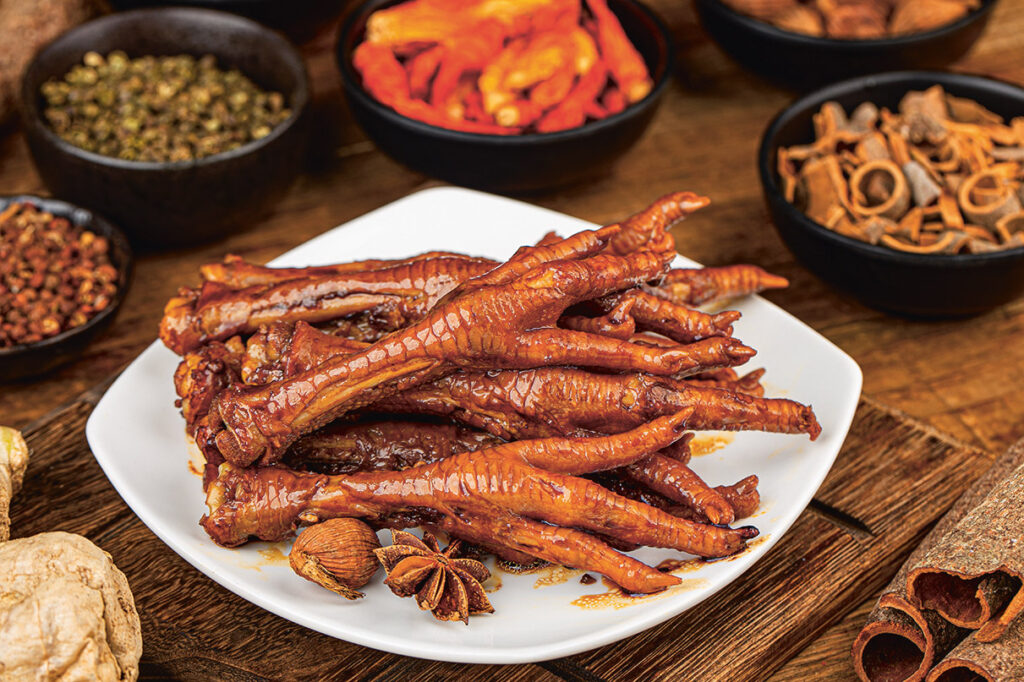
In everyday menus everywhere, Cantonese chicken feet are very popular – once this was also a popular festive dish. Now, however, it is like Russian Olivier salad: different variations have appeared, the recipe has found its way onto the menus of tourist-orientated restaurants and fast-food outlets. This dish is known as “phoenix claw” – in the modern variation, by the way, the claws are preferably removed during cooking. There are also other quite popular recipes based on this part of the chicken carcass.
Chicken feet have long been a familiar part of everyday and restaurant cuisine in China. Their popularity is primarily associated with their texture. There is little muscle meat in them, but a lot of skin, cartilage, and tendons. When properly prepared, these become soft, elastic, and slightly gelatinous, absorbing the sauce well, or so explains Konstantin Baraboshkin, connoisseur of Chinese traditions. At the same time, the expert notes that there is no single widely popular, all-Chinese dish made specifically from chicken feet. “In southern China, in Guangdong and Hong Kong, they are called ‘phoenix feet’, served in tea houses and dim sum parlours. They are usually fried first, then braised or steamed with fermented black beans and a spicy sauce. In Sichuan and Chongqing, cold marinated feet with hot pepper are popular. In other regions, there are braised, salted, spicy, smoked, and boneless versions. In recent years, lemon and pepper feet, sold as a ready-to-eat snack, have become widespread”, says Konstantin Baraboshkin. “So, chicken feet can be found in a wide variety of establishments. In a high-end Cantonese restaurant, it is a classic dim sum, preparation of which requires several stages and takes considerable time. At the same time, there is a huge market for inexpensive packaged snacks, products for convenience stores, and e-commerce. There is no specific national holiday for which chicken feet are traditionally served. They can appear at a family feast, banquet, or friendly gathering without any particular occasion.”
Russia produces more chicken meat today than it ever has. Per capita meat consumption in Russia is about 83 kg a year, with chicken accounting for the bulk of that figure. In addition to China, Russian chicken meat is exported to Saudi Arabia and Central Asian countries
The difference in culinary preferences works to the benefit of Russian exporters. “Chicken feet are only part of Russian exports (70%) of poultry products to China. In addition, wings, necks, backs, drumsticks, and various offal are supplied”, clarifies Lyubov Savkina, Director of Development at the AgroInsight agricultural analytical platform. “At the same time, the structure of Chinese demand differs markedly from the Russian. In Russia, breasts and fillets are most in demand while, in the PRC, many parts of the carcass that are of less value for the Russian consumer are in high demand. It is precisely the feet, wings, and offal that form a significant part of Russian poultry meat supplies to China. The country has become a market for Russian producers to monetize the part of the carcass in limited demand domestically. From an economic point of view, this is an extremely advantageous situation, as the producer receives additional export revenues from a product that of significantly lower value on the domestic market.” The expert notes that China has become an almost ideal market for selling Russian chicken feet. It is precisely these differences in consumption patterns that boost the overall efficiency of the poultry business.
Many major domestic suppliers work with China. According to data provided by Lyubov Savkina, the undisputed leader is the Resource Group of Agricultural Enterprises: by the end of 2025, this company accounted for about 45% of all Russian broiler meat products, including nearly 30 thousand tonnes sent to China. In addition, the main part of the Russian export offering on the poultry meat market comes from the companies Miratorg, Cherkizovo, Belgrankorm, and Damate.
Besides China, which accounts for 34% of Russian exports, the biggest buyers of Russian chicken meat are: Saudi Arabia (17%), Kazakhstan (17%), Uzbekistan (5%) and Kyrgyzstan (5%). Moreover, a peculiar seesaw has emerged in the structure of this demand. “Today, almost all types of cuts are exported, including drumsticks. Yet, supply volumes depend on the demand structure in a particular country. While China is most interested in offal, the Middle Eastern markets more often purchase parts of the carcass that are more familiar on the global market: whole carcasses or breasts. Exports of halal products to Middle Eastern states are growing especially rapidly”, notes Lyubov Savkina. “Turkeys should be noted separately. Russia has become one of the world’s biggest producers of turkeys in recent years and is actively increasing exports. The main producer and exporter of this type of meat is the Damate company. The main markets are China, Gulf countries, CIS states, and some African countries.” PR manager of the Agro. Club Anna Kirina notes that, according to the first results of 2026, Russia has become the leading supplier of turkeys on the world market, surpassing both Chile and the USA in supply volumes.
This unusual product, tonnes of which go to the neighbouring country, certainly evokes surprise and tenderness among ordinary people but this is a very good economic indicator, confirming that, in Russia, one needs to live a long life to witness historical and economic transformations. These metamorphoses can be very interesting.
“This is one of the most interesting symbols of the Russian agricultural sector’s transformation. In the 1990s, Russia was the biggest importer of American chicken legs, which received the popular name ‘Bush legs’. The turning point occurred roughly between 2005 and 2012. During this time, big investment projects were implemented; modern poultry complexes built and productivity increased significantly. The industry virtually achieved self-sufficiency”, says Lyubov Savkina. “After 2015, Russia already began to increase poultry meat exports actively. Today, almost all types of cuts are exported, including those same drumsticks.”
External factors also helped boost exports. For example, outbreaks of highly pathogenic avian ‘flu’ were observed on the world market among a number of major exporters, primarily in North and South America. This periodically limited supplies from certain enterprises and regions. So Russian producers found themselves in the right place at the right time: companies managed to obtain export permits and undergo veterinary admission procedures.
Ingredients for the Cantonese version of the “Phoenix Claw” dish:
500 g chicken feet
5–6 cm piece of ginger root
Bunch of spring onions
1 tbsp each maltose (or honey/sugar) and Shaoxing wine
3–4 cloves of garlic
Half an onion
2 star anises
1 stick of cassia (cinnamon)
2 tbsp fermented black soybeans
2 bay leaves
Water
Sauce:
1 tbsp each black bean sauce, Shaoxing wine, hoisin sauce, chili garlic sauce, chicken broth
2 tbsp each soy sauce, oyster sauce, sugar
1 tsp salt
Peanuts 50–80 g (pre-soak in boiling water for 2–3 hours)
Cooking method:
1. Wash the chicken feet thoroughly under cold running water. Remove any loose skin and clip the claws.
2. Cover the feet with water, bring to the boil and cook for a couple of minutes. Drain in a colander.
3. Slice the ginger. Chop the spring onions. Combine the garlic, cassia, bay leaf, Shaoxing wine, maltose, soy sauce, a little sugar and salt; put all these ingredients together with the onion and the feet in a pot. Cover with water and cook until tender over a low heat for about an hour, skimming off the foam periodically.
4. Heat vegetable oil in a deep frying pan. Fry the feet until golden brown.
5. Prepare the sauce from the ingredients listed in the recipe, pour it carefully into the frying pan with the feet, stir, then simmer for a few more minutes until the feet are fully saturated and coated in the glaze.
6. Place the finished feet on a dish, sprinkle with the pre-soaked peanuts and finely chopped spring onions.
The record figures are certainly pleasing. Even so, according to experts, it will be very difficult to maintain leadership this year. “According to ITC data, in Q1 2026, we are seeing a decline in both physical and value terms. The main risk lies with competitors who are not prepared to give up their place to Russia,” notes Lyubov Savkina. “Brazil has already significantly increased supplies and, if the USA restores volumes, competition will intensify. So, I would not view Russia’s leadership as a guaranteed long-term status. It is a result of a favourable combination of market conditions and systematic work on the part of Russian producers. Even so, Russia is quite capable of establishing itself among the leading suppliers and increasing supplies.”
According to expert forecasts, Russian suppliers will fight with doubled energy for the top places in the export ranking: without big export volumes, the Russian poultry meat market and the meat market as a whole will be oversaturated, purchase prices will fall, and producers will work without profit or at a loss. “Exports are now the most important area that needs to be developed”, concludes Lyubov Savkina. “Domestic poultry farms confirm the strategic effectiveness of exports to China. Most representatives emphasize both their readiness for greater cooperation and their active work with the export product range. Particularly interesting prospects are opening up for poultry complexes that have deliberately invested in reconstruction of workshops and opening of new poultry houses, taking into account Chinese veterinary and sanitary requirements. After all, a conclusion of full compliance with the standards opens access to the Asian market and growing sales. In general, availability of the necessary veterinary certificates and constant laboratory monitoring inspire confidence in Russian exporters”, notes Anna Kirina.


