
Translated with AI assistance
On October 17, the Shanghai Grand Opera House officially opened in Shanghai — one of China’s largest new cultural projects. The complex, covering an area of nearly 147,000 square meters, was built on the Huangpu waterfront and is set to become the new architectural centerpiece of the city’s cultural cluster.

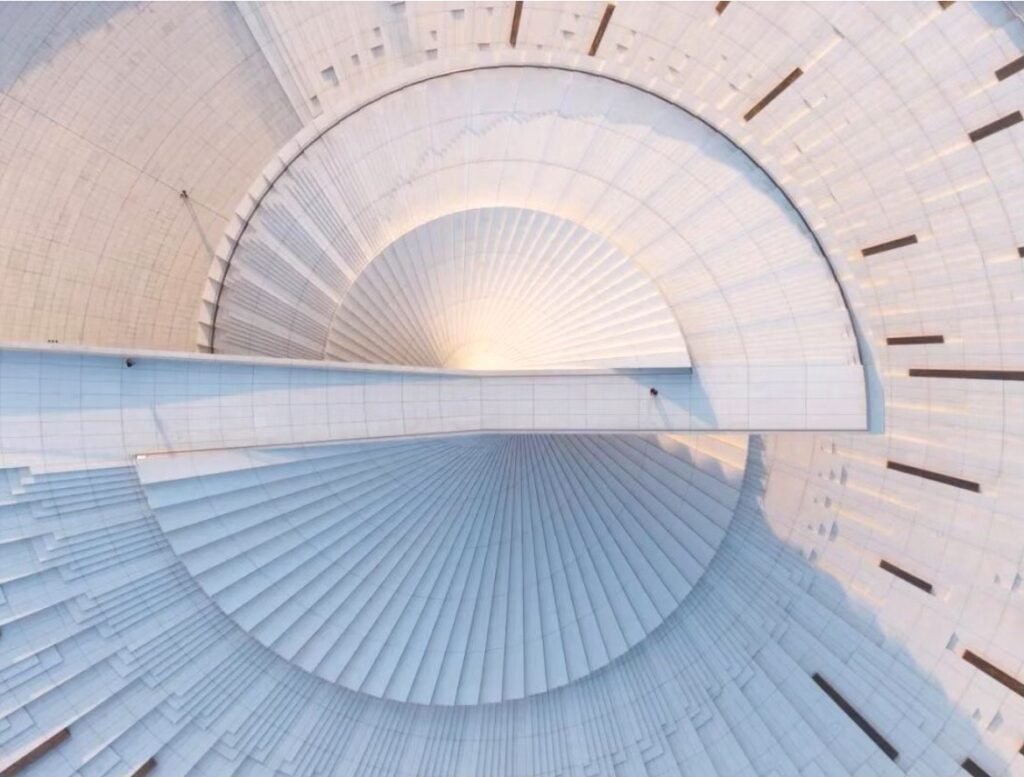
The building’s main design references a traditional Chinese folding fan. The enormous spiral roof appears to unfold over the embankment, while the central staircase forms its «ribs.» Moreover, the roof is part of the public space: you can climb it to reach an observation deck with views of the Huangpu River and the Shanghai skyline, even without a ticket to a performance.
Inside, there are three main halls with a total capacity of 4,200 spectators. The main Harmony Hall seats 2,000; its stage area covers approximately 3,500 sq. m, making it the largest theater stage in Asia. It features Asia’s first six-section stage system, which allows for the rapid changing of large sets. The other two halls seat 1,200 and 1,000 spectators respectively and are intended, among other things, for drama, chamber, and experimental productions.
For Shanghai, the theater is part of a much larger strategy to transform the city into one of Asia’s major cultural hubs. In the city’s development documents, the project was described as one of the key elements in strengthening Shanghai’s international cultural influence. In addition to the performance halls, the building now houses rehearsal and educational spaces, exhibition areas, libraries, restaurants, and public zones.
The first concert of the new theater – Shanghai Grand Opera House and Friends – simultaneously opened the 25th China Shanghai International Arts Festival, which runs from October 17 to November 15. The scale of the festival effectively turns Shanghai into one of the world’s performing arts capitals for a month. The program features nearly 400 projects and around 1,100 performances, concerts, exhibitions, and other events. The main theater program includes 60 productions and 170 shows; almost 90% of the productions are being presented in Shanghai for the first time, and for 13 projects the city will be their only stop in China. The professional performing arts fair is expected to bring together about 500 organizations and more than 2,000 participants from China and other countries.

The lineup features the Vienna Philharmonic, Venice’s La Fenice, the Berlin State Opera, American Ballet Theatre, and China’s largest theaters and orchestras.
The Russian presence at the festival this year is particularly large-scale. The Bolshoi Theatre has brought the ballet «Don Quixote» to Shanghai: performances will take place on October 21–23, and on October 24–25 the artists will present a gala program featuring excerpts from classic productions.
From October 23 to 28, Valery Gergiev and the Mariinsky Theatre Symphony Orchestra will perform all 15 of Dmitri Shostakovich’s symphonies at the new opera house — a cycle timed to mark the composer’s 120th anniversary. The Mariinsky Theatre will then present Verdi’s «Aida» conducted by Gergiev, a production that will serve as its Asian premiere.
The Russian New Theatre program will continue even after the festival concludes. In December, the Boris Eifman Ballet will hold its first full-scale Shanghai residency here. The lineup includes «Onegin,» «Anna Karenina,» and «Crime and Punishment,» with the latter production being shown in China for the first time.
Given the scale of the program and the lineup of participants, the opening of the Shanghai Grand Opera House is both an architectural event for the city and a statement of Shanghai’s ambition to claim an even more prominent place on the global cultural map.


