
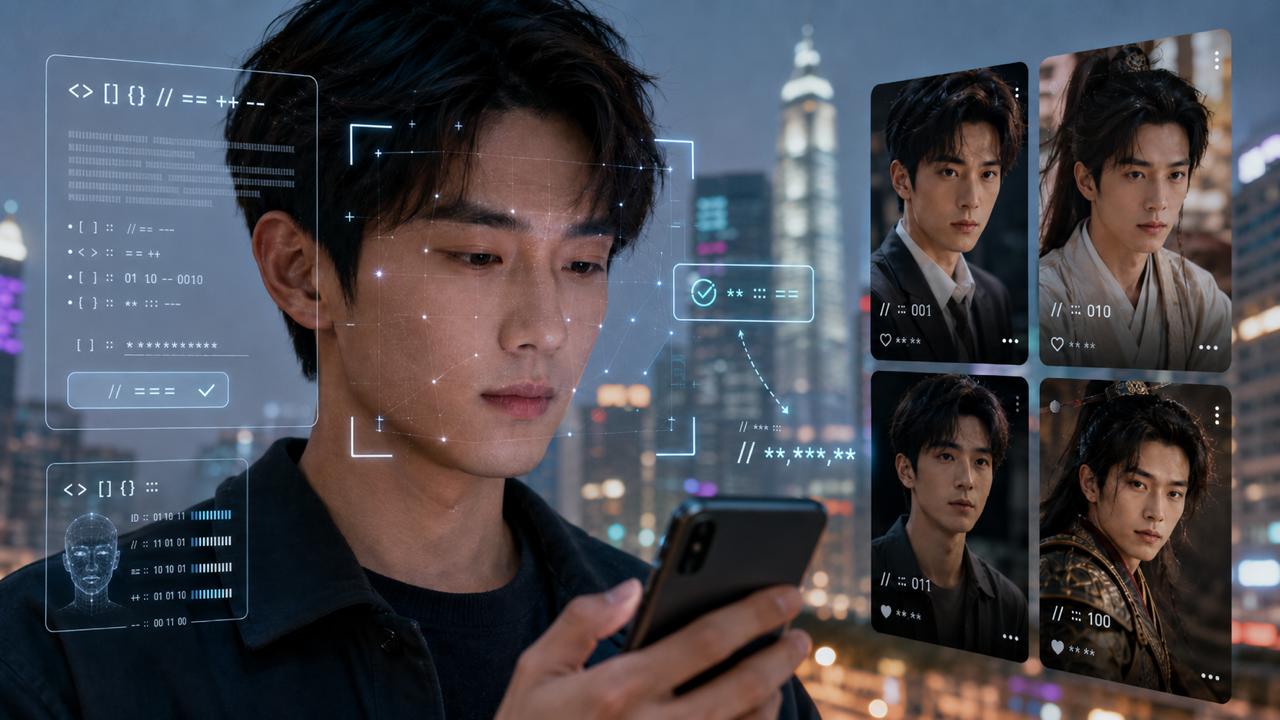
Amid the rapid growth of AI-generated content, online platforms have begun paying people for the right to use their faces in short vertical series. According to the technology publication Rest of World, users of such services can earn between $15 and $700 for licensing their likeness. Producers, for their part, select faces from catalogues according to gender, age, type and the genre of the prospective project. Unconventional looks, including the faces of older people, are in particularly high demand.
The Shenzhen-based platform ActID, launched in March 2026, has registered around 800 users; roughly 300 of them have agreed to license their likenesses for AI productions. According to the company, two AI dramas have already licensed around ten faces through ActID. Rates range from 99 to 500 yuan per episode, or approximately $15–74, with the platform taking a 10% commission.
Yet the market for “face rentals” is developing less as a new source of income than as an attempt to legalise what is already taking place without people’s consent. Ordinary users in China are increasingly discovering their likenesses in AI microdramas in which they never agreed to appear. In one high-profile case, two influencers accused ByteDance’s Hongguo platform of using and altering their faces without permission; the microdrama attracted more than 40m views and was subsequently removed. ByteDance said that, since the beginning of 2026, it had taken down more than 85,000 videos involving the unauthorised reproduction of faces and voices.
How the Microdrama Industry Works
The microdrama industry—vertical series made for smartphones—is, in essence, a high-speed factory for mobile content. Episodes typically last between one and three minutes and are built around storytelling of maximum intensity: conflict, a sharp plot twist, a cliffhanger—cutting off at the most compelling moment—and payment for the next episode. China has taken this model to an industrial scale: in the first quarter of 2026, around 128,000 microdramas were produced in the country, with more than 95% of them using AI in production. According to Channel NewsAsia, the figure had been close to zero a year earlier.
The format’s economics rest on low production costs, rapid testing of storylines and aggressive in-app monetisation: viewers watch the beginning for free and then pay to continue—through a subscription, advertising or the purchase of “coins”. According to NBC News, China’s minidrama market is valued at around $14bn. At the same time, the model is being exported rapidly: Deloitte forecasts that global microdrama revenues could rise from $3.8bn in 2025 to $7.8bn in 2026.
Microdramas for Export
BRICS+ countries are becoming one of the natural areas of expansion for the format. In India, according to The Economic Times, at least 15 microdrama apps are already operating, while a ten-episode season without major stars can cost as little as $2,600–5,200 to produce. In Brazil, ReelShort and Endemol Shine Brasil launched a local adaptation of the microdrama Married at First Sight—De Repente Casados. In Russia, the format remains at an early stage: Ivi announced the launch of a minidrama section in its mobile app, while Cheboksary-based Kinolenta brought Russian microdramas to the Chinese platform ShortMax.
The irony of the new economy is that microdramas began as a cheap form of mass entertainment but have evolved into a laboratory for the future market in identity. China is already testing a model in which a face can not only be shown, but also rented out, licensed, monetised and—quite possibly—placed beyond its owner’s control. For BRICS+ countries, the question no longer sounds quite so fanciful: will Chinese microdramas soon be followed by the next consumer proposition—“rent out your face for AI content and earn passive income”?
Photo: AI-generated


