
Artificial intelligence has upended the established energy market rules. As AI models become more complex, their energy consumption rises exponentially, exacerbating the global capacity deficit. This creates a unique export window of opportunity for BRICS countries: a shift from selling raw materials to commercializing computational energy.
Editorial translation

According to the International Energy Agency (IEA), the global demand for electricity grew by 4.4% in 2024 and is expected to rise another 3% in 2025. Forecasts indicate that the average annual rise in demand through 2030 will be 50% higher than the average over the previous decade. The primary driver of this sharp spike in electricity demand is the explosive growth of the data centres essential for training and running AI models.
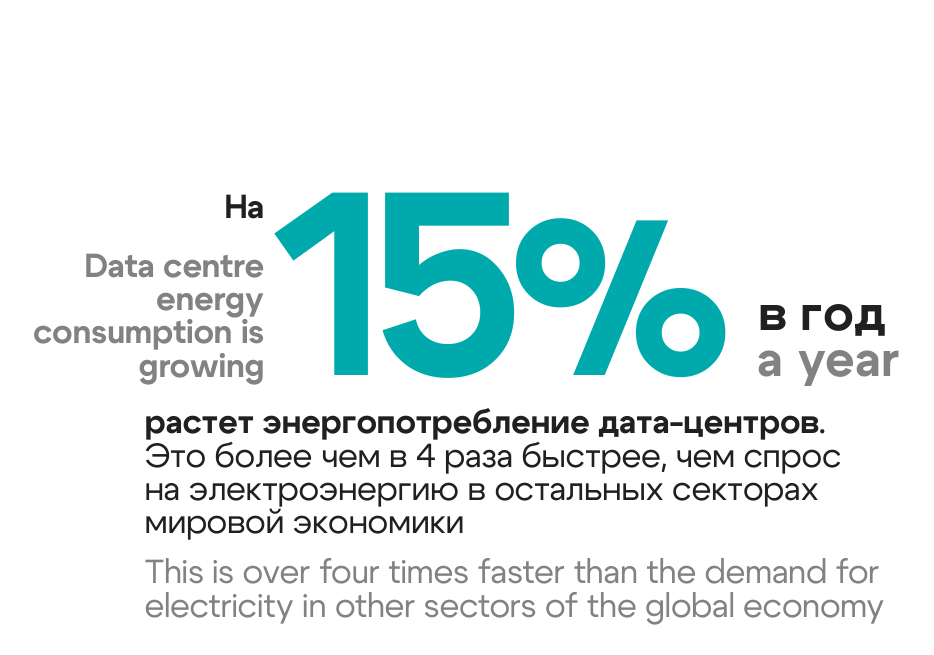
“Global data centres consumed approximately 447 TWh in 2025. In 2026, consumption will go up by 26%, to 565 TWh, and, by 2030, it is projected to surpass 1,200 TWh”, cites Alexander Kudryashov, Senior Lecturer at the Department of Economics and Finance of the Moscow Regional Branch of the Russian Presidential Academy of National Economy and Public Administration (RANEPA). According to the expert, this segment is itself growing by about 12% annually, which is quadruple the overall electricity demand. Even now, a single big AI-orientated data centre consumes between 100 and 500 MW, roughly the equivalent of a medium-sized city.
In Russia, data centres have already become a notable factor in energy consumption, according to Timur Kotlyar, CEO of Nord Energy. Over three years, their share in the overall structure has doubled from 1.4% in 2022 to 2.2% in 2025. Currently, the connected capacity of data centres, including mining, stands at 4.2 GW. According to a forecast by the System Operator of the Unified Energy System, over the next five years it could reach 15.3 GW, a nearly fourfold increase. Among BRICS countries, China and India are seeing the most active growth in energy consumption. As Timur Kotlyar notes, China, along with the United States, will account for about 80% of the global increase in data centre electricity consumption by 2030. In China alone, data centre consumption will rise by 175 TWh. India is also gaining momentum: according to Deloitte forecasts, the capacity of Indian data centres will grow from 1.5 GW to 8–10 GW by 2030.
As explained by Dmitry Kuznetsov, Director of the System Integration Department at UTSB, AI infrastructure consumes orders of magnitude more energy and computing resources than traditional IT systems, owing to their fundamentally different information processing methods. “A traditional IT process operates on the basis of deterministic logic (algorithms) with minimal energy consumption. AI, however, works on the basis of probabilities and linear algebra. To produce a single response (even if it is just one word in a chat), a neural network must perform billions of multiplication and addition operations. So, the chips (GPUs) used for AI work contain thousands of small cores for millions of parallel computations. At peak load, each such chip consumes 300–700 watts or more.”
Ildar Sattarov, CEO of the Alliance of Advanced Technologies, points out that AI is becoming more economical year by year. “Recently, Google disclosed its measurements: one text query to their model consumes about as much electricity as a microwave oven uses per second. A year earlier, the same query was 33 times more expensive”, the expert said. The International Energy Agency emphasizes that the AI energy efficiency for each individual task improves tenfold annually due to advances in software and hardware, this being an unprecedented rate in the history of energy. “There is no contradiction here”, notes Ildar Sattarov. “Back in 1865, the economist William Jevons observed that the more efficient the steam engine became, the more coal was burned in total in England. A cheaper machine meant there would be many machines.” The same process is now under way in AI. Neural networks are becoming more accessible and efficient, leading to their widespread implementation, which, in turn, increases the load on data centres and power plants.

Work with neural networks has also changed in nature. “Previously, the main load on networks came from one-time model training but the current explosive growth is driven by inference (use of models by end users in real time). Energy intensity also depends heavily on the task: simple text generation requires about 2 Wh per query, big reasoning models consume at least twice as much, while generating a short video takes about 25 times more than text”, noted Leonid Kalimullin, Head of Mosstat. “There is a transition to multi-agent systems, where several AI agents work in parallel, negotiate among themselves without human intervention, and shuttle tasks back and forth”, commented digitalization expert Alexey Onosov, founder of Unisoft. As a result, the number of computational cycles continues to grow.
Energy is needed not only for computations. According to Dmitry Kuznetsov, when high-performance chips are in operation, data centre equipment heats up intensively. To prevent it from failing, data centres require powerful air conditioning or liquid cooling systems, which consume 30 to 40% of all electricity supplied to the data centre.
The rapid development of AI is causing an energy capacity shortage. The main threat is not so much rolling blackouts as grid constraints and economic imbalances, according to Leonid Kalimullin. Owing to grid congestion and transformer shortages, up to 20% of planned data centre projects worldwide are already at risk of serious delays. For example, the Moscow hub, which historically accounts for more than 60% of the country’s commercial capacity, has exhausted its limits for technological connection, noted Dmitry Kuznetsov. He states that grid companies have effectively imposed restrictions on connecting big new data centres owing to energy shortages and record peak consumption at the capital’s hub. A similar picture, according to Ildar Sattarov, is emerging in the South, the southeast of Siberia, and the Far East.
According to Sattarov, the problem is not so much an energy deficit as a mismatch in the pace of data centre construction and energy infrastructure development. “A data centre can be built in a year or eighteen months. A power transmission line takes five to seven years to build. A big power transformer used to be delivered in two years; now it takes three to five. Big gas turbines are made by only three companies in the entire world, while their order books are full five years ahead. Electrical equipment accounts for less than a tenth of the cost of a data centre, while it constitutes 100% of the bottleneck”, the expert emphasized.
If new AI capacities begin connecting to existing infrastructure without it being expanded, the consequences will be serious, warns Timur Kotlyar. Data centres will compete with new factories or residential neighbourhoods for technological connection. The cost of technological connection will rise: for a scarce resource, one will have to pay more. Dmitry Kuznetsov speaks of the risk of tariff imbalance: to retain AI companies within the country, governments might offer them preferential wholesale tariffs. The revenue shortfall for energy grid companies will be compensated by raising tariffs for household and business end consumers. “There is also a less obvious risk: grid instability”, believes Timur Kotlyar. Sharp load surges from AI clusters create problems with power quality, can trigger emergency outages, and accelerate wear and tear on grid equipment. In essence, an energy system designed for uniform consumption is facing a completely new type of load.
National approaches to solving the energy shortage problem vary significantly. In Russia, for example, according to Dmitry Kuznetsov, data centre developers are relocating projects to regions with a generating surplus (the Leningrad, Tver, Smolensk, and Tomsk regions), where it is possible to connect hundreds of megawatts. In addition, the government plans to create special energy zones for data centres with expedited grid connections and special tariffs.

To address the problem of grid congestion, China has launched the national “East Data – West Computing” project: capacity from the overloaded eastern coast is being relocated to regions with an abundance of cheap wind and hydro power (Inner Mongolia, Guizhou).
Indonesia has surplus energy, so the main problem is related to developing electricity transmission and distribution networks, said Roman Fainshmidt, an Orientalist and specialist in the economies of East and Southeast Asia. Moreover, large international companies are obliged to follow ESG principles, which impose certain environmental obligations on them when most Indonesian electricity is generated at coal-fired plants. So, Indonesian companies are negotiating use of geothermal and solar energy for data centres. The Indonesian Data Centre Operators Association is also preparing a national environmental rating system to monitor the energy efficiency of data centres across the country.
Use of alternative energy sources has become a trend in other countries as well, notes Evgeny Sumarokov, Associate Professor at the Department of International Business of the Financial University under the Government of the Russian Federation: “Big companies responsible for development of data centres are trying to compensate for electricity consumption by building wind and solar power plants to supply them with energy.” The CEO of the company Plusofon notes that technology giants are increasingly adopting an “all the above” strategy, combining all possible energy sources: renewables, gas, nuclear.
Access to cheap energy will eventually become as vital macroeconomic factor as access to oil or capital used to be, believes Alexey Onosov. At the same time, BRICS countries are in an advantageous position. “More than half the world’s generation is located here, half the world’s solar output, a record 497 GW of solar and wind capacity having been introduced in 2025 alone. The portfolio of future renewable energy projects is 2.5‑fold bigger than that for coal, oil, and gas combined. The raw material for computation is available to the bloc”, emphasized Ildar Sattarov.
Russia, Brazil, and China possess what many developed countries lack: affordable energy and construction territory, Timur Kotlyar also believes. Global demand for computing power is growing faster than the ability of traditional centres in the US and Europe to meet it. “This opens a window of opportunity for BRICS countries”, says the expert. “Russia, for example, can offer relatively cheap electricity, a cold climate (which reduces server cooling costs), and large areas for construction. India offers skilled personnel and a growing domestic market. China is already a world leader in data centre capacity.”
The question, however, is that surplus capacity alone does not confer an advantage: electricity as a commodity is traded with a raw material margin, notes Anna Rayskaya, CEO and founder of AIVOLUTE, an expert in AI implementation and business automation. An asset, in her words, appears when a megawatt is transformed into computation, and computation is sold as inference, tokens, or trained models. According to Ilya Margolin, a public administration and international policy consultant, if the energy advantage is combined with industrial policy, microchip production, data centre construction, and development of indigenous AI platforms, then BRICS countries will be able to export computing power as an independent economic product.
Sergey Andronov, Director of the Centre for Network Solutions at Infosystems Jet, believes a country that can offer investors a comprehensive “package” solution will win the technology race. This requires four key conditions. First and foremost, relatively inexpensive generation: owning generating capacities (nuclear, hydro, gas) and, critically, a low final electricity price for the consumer. A high-speed and fault-tolerant fibre-optic infrastructure must be built for transmitting huge volumes of data. Fast permission procedures and favourable rules for investors are needed: preferential technical connection and transparent investment portfolios. A cool climate, which minimizes equipment cooling costs, would be an added bonus.
In addition to a cold climate and capacity surplus, Russia has another important advantage. According to Leonid Kalimullin, the structural surplus of generating capacity in Russia is provided by low-carbon and dispatchable (controllable) generation, both nuclear and hydroelectric power. “Russia still has significant untapped hydro potential, especially in the Far East”, notes the expert. “Hydropower is a renewable energy source and one of the cleanest forms of generation, with no direct CO₂ emissions during electricity production. This is a potential competitive and even export advantage for us: hydropower can serve as an ideal, stable baseload for data centres, radically reducing the AI infrastructure carbon footprint. At the same time, Russia ranks second after China in hydropower resources.”
To overcome the energy deficit, comprehensive technological solutions at the intersection of energy, thermal engineering, and AI algorithms are already taking shape in the AI field, said Dmitry Kuznetsov. For instance, small modular nuclear reactors could play a key role, enabling completely autonomous “AI factories” to be created anywhere in the world.
Another way to reduce energy consumption is to install advanced cooling systems at data centres: liquid or immersion cooling, where servers are fully submerged in a dielectric fluid. “Such solutions allow a reduction in Power Usage Effectiveness (PUE) in AI clusters from the usual 1.5–1.6 to 1.15–1.2”, Dmitry Kuznetsov gives an example. According to Leonid Kalimullin, promising directions include developing architectures like Mixture of Experts (MoE), which activate only the requisite part of the neural network for a specific query, saving up to 90% of computing resources. In parallel, photonic computing technologies are being developed (transmitting data using light instead of electricity), promising a multiple reduction in heat generation. Within a three-to-seven-year horizon, we can expect a transition to specialized NPU chips for neural networks, predicts Ildar Sattarov. He states that energy is currently being spent by universal accelerators on a very narrow operation, roughly like “carrying bread in a dump truck”. Furthermore, AI can also be used to optimize the energy sector itself. According to Leonid Kalimullin, this will help with dynamic load distribution, forecasting temperature conditions, and early detection of incidents on critical infrastructure.
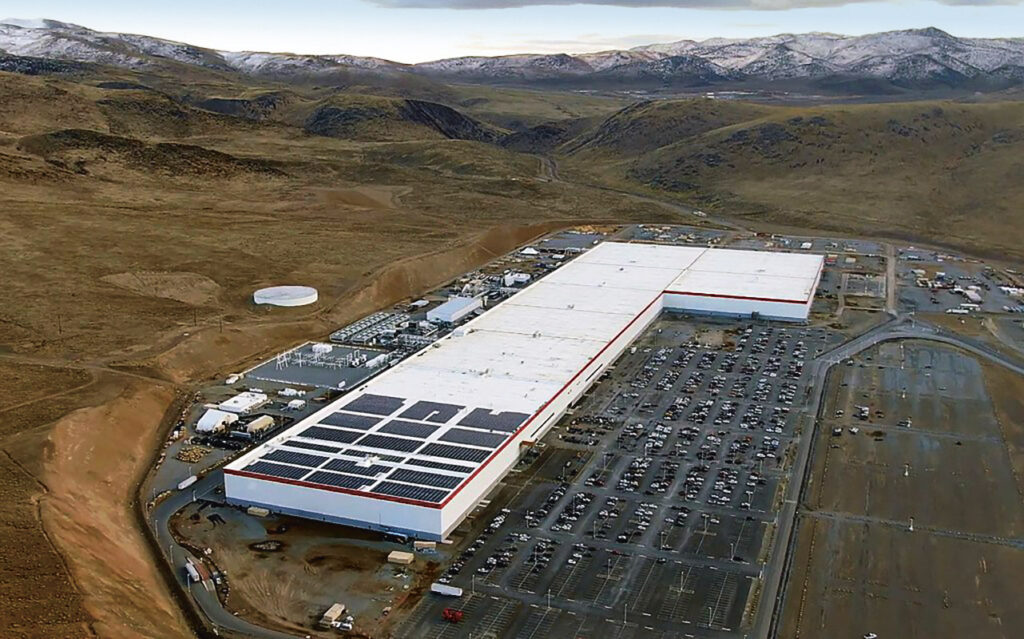
Timur Kotlyar considers a transition to a fundamentally different power supply architecture is required: to the so-called hybrid energy system. It includes three components: own gas piston generation (GPU), energy storage systems (ESS) based on lithium iron phosphate batteries, and an intelligent control system balancing consumption between sources in real time. “Such a combination solves several problems at once: it provides an uninterrupted power supply, reduces dependence on the external grid, lowers operating costs, and allows for rapid capacity scaling without waiting for lengthy technical connection procedures”, says the expert. According to him, the biggest data centre operators in various countries are already switching to such hybrid schemes. For BRICS countries, this is also an opportunity to develop their own production of energy equipment: batteries, generators, control systems.


