
We believe that the current shift in the technological and consumer paradigm in the global automotive industry should be viewed as a unique chance to bridge the gap that separates us from the leaders of the world industry and to participate in the creation of new products, new technologies, and new client services with a market that is estimated to reach $6 trillion by 2030.
That is why the SOLLERS Group is now launching several projects at once, which will completely transform the existing business landscape of the company by 2020. The projects in question are in the areas of new mobility, the implementation of the concept of digital production, and the development of new technologies for electric transport.
We focus on the needs of our traditional clients, the large infrastructure companies. Until recently, they owned and operated large fleets of vehicles to meet their own needs. We are starting to provide transport outsourcing services, taking on fleet management ourselves, and invoicing for each hour of real use of the vehicle. And in parallel, we are developing a fleet management platform, which will, in effect, automate the management of the entire fleet. This platform is built on telematics solutions, allowing online collection of information on the location and status, fuel consumption, driving style, etc., of each vehicle. Moreover, as part of the solutions being developed, it will be possible to remotely diagnose or remotely simulate the performance of the vehicle systems. As the functionality of autonomous control systems develops in the car itself, the fleet management platform will allow for, in essence, programming and remotely providing the required mode of vehicle operation, thus minimizing the influence of the human factor. With the help of this platform, there will also be a continuous analysis of the fleet parameters that will constantly optimize the maintenance costs of the fleet and ensure its full utilization and maximum efficiency. The fleet management platform will become the basis for our new model of working with large corporate clients, but we will also promote the platform itself as a separate IT product on the market.
Another area that UAZ is actively engaged in now is the creation of a package of multimedia and infotainment customer services that can be customized for each driver’s needs, based on their need for information, services behind the wheel, and their interests and hobbies.
Another new project is the implementation of digital production technologies and the creation of digital factories based on our factories in Vladivostok and Ulyanovsk.
The essence of this project is the development of a set of technologies for the total automation of production management, as well as for digital design of production processes and the creation of the so-called digital clone. This will allow us to digitize, optimize, and improve all production operations, perform virtual testing and commissioning of equipment, carry out predictive analysis of the factors causing flaws or breakdowns, and, finally, significantly reduce time necessary to launch new products.
The digital factory project integrates a number of innovative solutions such as industrial Internet of Things or the use of augmented reality technologies at work stations. Based on the results of the pilot project in Vladivostok, our goal is to build an out-of-the-box solution called “digital factory’ that can be used in any industrial enterprises. And since such solutions are still unique not only in Russia but anywhere in the world, we aim for this pilot project based on a real operating production line in Vladivostok to allow us to enter the APEC market with this product.
With UAZ as a foundation, the digital factory project will envisage the creation of a digital clone, not only of a production line but also the product in order to allow us to significantly accelerate the development and launch of new models, and most importantly, to realize the dream of any niche manufacturer: to be able to quickly customize the product for each specific client need and mass-produce any customized versions at the assembly line.
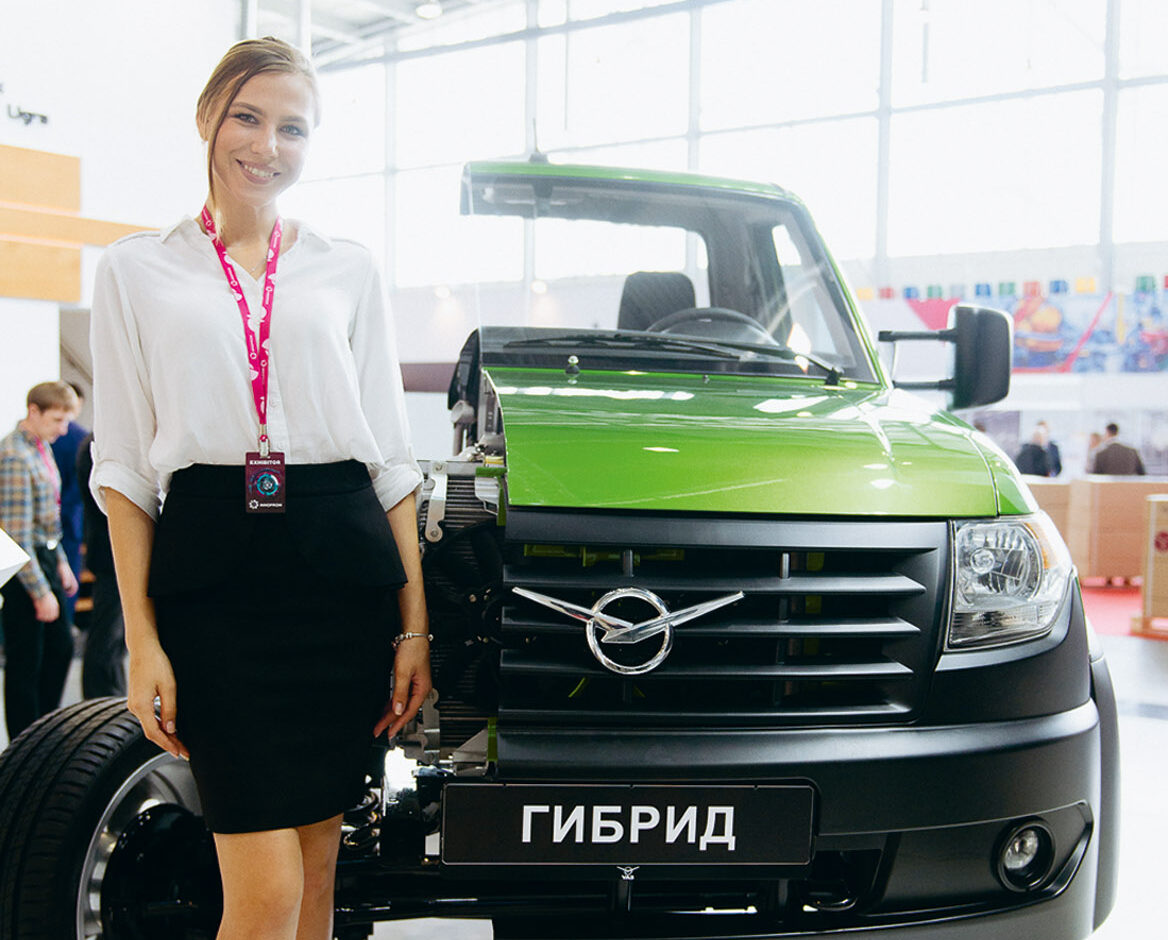
This year, we started the project of creating a new cargo-and-passenger hybrid platform. The future hybrid under the UAZ brand should have a maximum mileage of 100 kilometers per charge, a maximum cruising range of 1,000 km, on a single tank, fuel consumption of less than seven liters per 100 km, satisfy the Euro 6.2 emission standard, and have a battery charge time of no more than 3.5 hours. The hybrid platform will provide our customers with a 40% lower total cost of ownership compared to a gasoline equivalent, and a reduction in CO2 emissions will allow us to export it to EU markets while being able to receive tariff preferences when operating in Europe. At the first stage, the project will be fully export-oriented: In addition to Europe, our largest target market for hybrids will be China. But on the horizon, after 2020, we predict that the share of hybrids in Russia will start to grow and reach about five to six percent of total volume. The main challenge that we face is the Russian cell platform for electric transport, including batteries and electric motors. We would like to solve this problem as part of a consortium with Russian automakers, engineering centers, innovative companies, and universities.


