
United Aircraft Corporation enterprises are implementing industry technologies 4.0. This will bring about a radical change in internal processes and give the company a competitive edge on the global market.
Enterprises that form part of the United Aircraft Corporation have started to produce bionic design parts. Printed on a 3D printer, they look different from most of the structural elements designed in the last decades. Thanks to their lower mass and simplified production requirements, they are likely to displace the parts that are built based on traditional technologies.
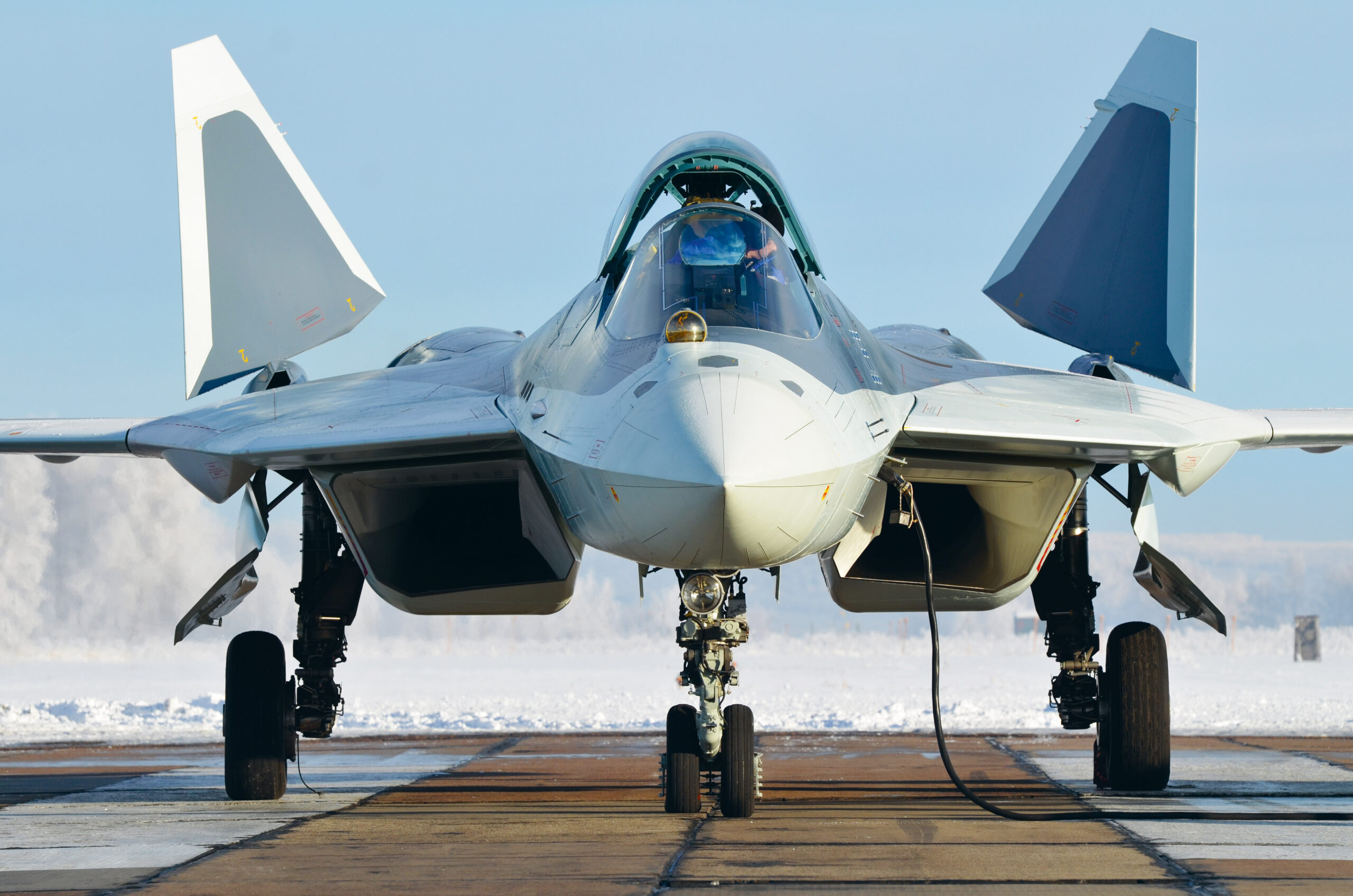
The Sukhoi company has developed the first spare part based on the bionic design approach – an aluminium power bracket for the new jet fighter. So far, there have been so few examples of spare parts that were successfully built based on new technologies and printed on a 3D printer that one could literally count them on one hand.
The bracket was developed 100% domestically. The part was designed with the help of a supercomputer by Sukhoi company designers and printed on a 3D printer using domestically produced metal particle aluminium composite alloy developed by the Russian National Scientific Research Institute for Aircraft Materials (RIAM). Its design is more reminiscent of a pre-historic animal bone rather than a spare part to be used in a fifth-generation fighter jet.
Thanks to some of its technological properties, the new spare part is very unlikely to collect dust on a shelf in a museum. The new bracket is one-fourth lighter than its predecessors that are used in operational aircraft today and were produced based on traditional technologies. The entire precess – from designing the part from scratch to adapting the technology and serial production launch – took several months.
There is another significant nuance – the spare part that is nearly one-and-a-half meters long was manufactured using a laser sintering method over just one night. The traditional aluminium processing approach would have taken up at least a week. The 3D printing capabilities made it possible to create cavities that the usual manually programmed machine tool would have taken weeks to ‘carve through’.
The generative design is a way of developing objects whereby non-traditional solutions are used to reduce weight and increase strength. Objects produced this way appear different from those made based on conventional technologies. Their properties are more akin to those of plants – for instance they can imitate the structure of extremities or bones. Which is why this design approach is often referred to as bionic.
The term ‘generative design’ is predicated on the fact that the geometry of such structures is automatically calculated or generated by a specific software. It is as if someone had delegated his or her powers to a computer technology. The main objective of the bionic design approach is quite logical – to reduce the object’s weight and at the same time retain or even increase its original durability.
This is why such solutions are often used in areas where every gram counts, including the aircraft-building industry. The generative design approach also accomplishes the secondary task of saving expensive materials, such as composite alloys and rare metals. In some technological processes, the bionic approach makes it possible to spend 30% and even up to 50% less materials. Naturally, it produces a positive effect on the price of such articles.
In most cases, making constructs based on the generative design approach is only possible with the help of adaptive technologies (i.e. a 3D printer), which build physical objects layer by layer based on a 3D model. The problem is that traditional methods of production do not lend themselves well to complex projects that include unconventional elements, which is something the bionic design approach can offer. 3D printing on the other hand, makes it possible to build any elements with any width, curvature, cavities, and meshed or cellular structures. In addition, because bionic objects are built layer by layer, it increases even further their strength and stress resistance.
The first 3D printing test job was successfully completed here in Moscow using specialized VIAM equipment and a printer with purpose-designed domestic aluminium printing powder. Meanwhile, the Sukhoi Experimental Design Bureau has its own 3D lab where dozens of various aircraft parts are built using stereo lithography.
Fighter pilots are well familiar with the parts produced based on this method. For instance, the Sukhoi EDB quickly managed to find the optimal design for its aircraft control stick. Building on the feedback received from pilots as to the most convenient location of control buttons, they managed to quickly improve the initial design (where the pilots were not always able to reach the buttons with their fingers) and offer a more fitting solution.
For instance, the aircraft control pedal is also printed using a layer-by-layer synthesis and then cast in iron. Hybrid design methods make it possible to quickly improve the design of selected units, such as brackets, and launch their serial production. Many parts are made for master models of new aircraft.
As digital technologies are used at all design stages, today, it enables the aircraft building industry to accomplish things that seemed impossible yesterday – for example, building a robust and elegant part with a minimum mass in one working day by using the most advanced calculation and optimization methods, then printing it in the next room tomorrow, conducting a test the day after tomorrow, and finally installing it on an actual aircraft just one week later. Engineers from Irkut corporation are already working on this fantastical idea in earnest. A little over a year ago, the corporation started implementing topological optimization approaches to design.
The Irkut corporation approached the selection of prototype for running its research very seriously – they brought on board the director of its Design Bureau, chief technology officer and deputy chief designer responsible for durability. They finally settled on an assembly unit with a complex configuration consisting of more than 28 parts that was not connected to key engine elements.
The part is not engaged in flight, and its operational purpose has nothing to do with in-flight external stress or excessive pressure. It took them two weeks to design and build the first prototype, which is a long time in terms of the ‘additive philosophy’. They did not want to rush it prioritizing quality. They first showed their topological optimization results to designers, calculated the prototype’s power flux, and only then came up with a compromise-driven design that combined traditional constructive solutions with bionic design elements. Twenty-eight segments were replaced with one single part.
When a 3D model is ready, it should be adapted for printing, which cannot be accomplished without intimate knowledge of the ‘additive’ methods. Irkut designers fell back on their long-standing cooperation with the STANKIN Moscow State Technological University and came up with an effective scientific and industrial alliance between a real-life design developer and an academic institution with a research lab of its own. This work piqued a great deal of interest among other hardware manufacturers, and such companies as SLM Solution (Rusky Group) and Concept Laser quickly got on board. As a result, they built several prototypes scaled to 40% in various configurations using aluminium, titanium, and steel alloys. These prototypes attracted the attention of the N. E. Zhukovsky Central Aerohydrodynamic Institute (CAI) – a preeminent aviation scientific center, which ran real-life stress testing. The results obtained showed that further development of this innovative area is well worth pursuing.
Today, Irkut has put together a working group tasked with implementation of adaptive technologies. Group members include durability experts, designers, and technology officers, and the corporation enjoys a robust cooperation with partner organizations.
UAC President Yuriy Slyusar talks about the approach that enables the corporation to save time and money.
Digital technologies are already widely used in the aircraft building industry. The priorities identified by the president for transforming the economy based on industry technologies 4.0, diversification and development of export capabilities are being translated into some very specific tasks. These have to be addressed based on broad implementation of digital technologies that would transform the entire industrial landscape. For us, this means a specific business objective – to design, build, and market new products faster and quickly ensure they are supported throughout their operational cycle with the requisite level of quality.
For instance, digital design made it possible to significantly change our production process as well. Thanks to the digital model, now we are able to use the jigless assembly approach in building glider elements and dock them automatically. During the pre-digital era, it took many months to assemble an aircraft body, whereas now it takes just days. We use supercomputer technologies developed in our country to perform mathematical modeling of the SU-57 cannon unit, which enabled us to reduce the time it takes to develop its design by many months, saving tens of millions of rubles in the process. The topological optimization approach made it possible for us to reduce the weight of complex parts by 15% to 20% in a series of SU-57 components.
Our experience shows that the upcoming implementation of augmented reality technologies in civilian programs will enable us to reduce the time it takes to assemble a complex cabling system by 25% and the number of errors would be halved.
Another key area of our operations is reducing real-life tests of aerodynamic properties, durability properties, on-board equipment, control systems, and combat mode tests by 35% based on mathematical modeling and moving digital tests forward to earlier stages of the product’s operational cycle.
This experience coupled with best practices developed in other high-tech industries can be replicated across the entire Russian industry, enabling it to build competitive products offering a high export potential.
The digital transformation of our industry requires the implementation of the ‘open innovations’ model. At UAC, we are taking proactive steps to implement this model. We are working with the Moscow Institute of Physics and Technology, St. Petersburg Polytechnic University, and Moscow Aviation Institute to get young engineers on board in the framework of the Aviation of the future program. Together with the Russian Venture Company (RVC) and Skolkovo we are taking part in an industrial venture fund designed to ‘draw’ promising projects into the corporation’s operational orbit. Based on the same logic we joined forces with several regions to test-drive the format whereby small- and medium-size industrial businesses could contribute toward achieving the corporation’s strategic objectives.


