
After decades of Western dominance, BRICS+ is steadily assembling its own space architecture – combining the technical capabilities of China, Russia and India with the ambitions of emerging members from the Global South. Joint programmes, from satellite constellations to orbital stations and lunar missions, are shaping an autonomous space ecosystem supported by shared infrastructure and rising private-sector participation. At the same time, the bloc is promoting alternative governance principles focused on inclusion and peaceful use of orbit, positioning itself against NATO’s militarisation trend. Together, these dynamics point to the emergence of a new spatial order, where astropolitics reflects the broader multipolar system taking shape on Earth.
In the last few years, space has established itself as an invisible but essential infrastructure for the global economy and governance. Unlike the Cold War space race, which was largely dominated by symbolic logic and ideological rivalries, the current phase is driven by concrete applications that feed economic growth, technological innovation and the resilience of contemporary societies. The most recent estimates indicate that the sector, valued at approximately £630 billion in 2023, could almost triple by 2035 [1], with growth rates well above the global GDP average. In this context, the BRICS+ countries, combining established expertise in the sector (China [2], India [3] and Russia) with new members Egypt, Ethiopia, Iran, the United Arab Emirates and, most recently, Indonesia, are emerging as key players in the realm of “spacefaring” [4] nations. The enlargement not only expands the pool of resources and diversifies technical capabilities but also strengthens the potential to build an alternative pole in global space governance. Despite the presence of heterogeneous national interests, the group can develop forms of cooperation capable of reducing asymmetries, increasing technological autonomy and consolidating the identity of the global South in space.
Space cooperation between BRICS+ countries has developed gradually, evolving from bilateral initiatives to an increasingly structured institutional framework. The first major projects emerged in the 1980s and 1990s, such as the CBERS programme between China and Brazil (1988) [5] — one of the longest running [6] Earth observation systems in the global South — and Russian Indian collaboration in the fields of satellite navigation and manned programmes [7]. Yet, these were still fragmented experiences, lacking common coordination. A first major turning point came in 2015, when the joint declaration at COPUOS [8] and the Ufa summit officially included space among the partnership’s priorities. On that occasion, the members committed themselves to promoting the peaceful use of orbit and preventing the militarisation of space, while outlining the first areas of shared cooperation [9]. The quantum leap came in 2021 with the establishment of the BRICS Earth Observation Constellation, based on the integration of national satellites and the systematic exchange of data [10]. The following year, the creation of the Joint Committee for Space Cooperation gave this instrument a permanent dimension, promoting coordinated campaigns and the adoption of common standards [11]. Finally, the very recent 2025 Rio summit has marked the entry of cooperation into a fully political-institutional phase, with the establishment of the BRICS Space Council [12]. The Declaration adopted at the meeting reaffirmed the goal of inclusive and sustainable cooperation, aimed at reducing inequalities [13] in space capabilities and enhancing technological differences as a factor of shared innovation [14].
In just over a decade, BRICS+ space cooperation has thus moved from bilateral initiatives to an institutional architecture capable of proposing alternative models of governance, projecting into space the multipolar vision pursued on Earth as the group.
The evolution of space cooperation among the BRICS+ countries is set to intensify in the coming years, reflecting both the technological and economic needs of individual states and the political goal of building a multipolar international order. The distinctive feature is not only the amount of resources invested, but also the group’s ability to translate its economic [15] and demographic weight [16], which already exceeds that of the G7, into concrete influence over the future of space governance.
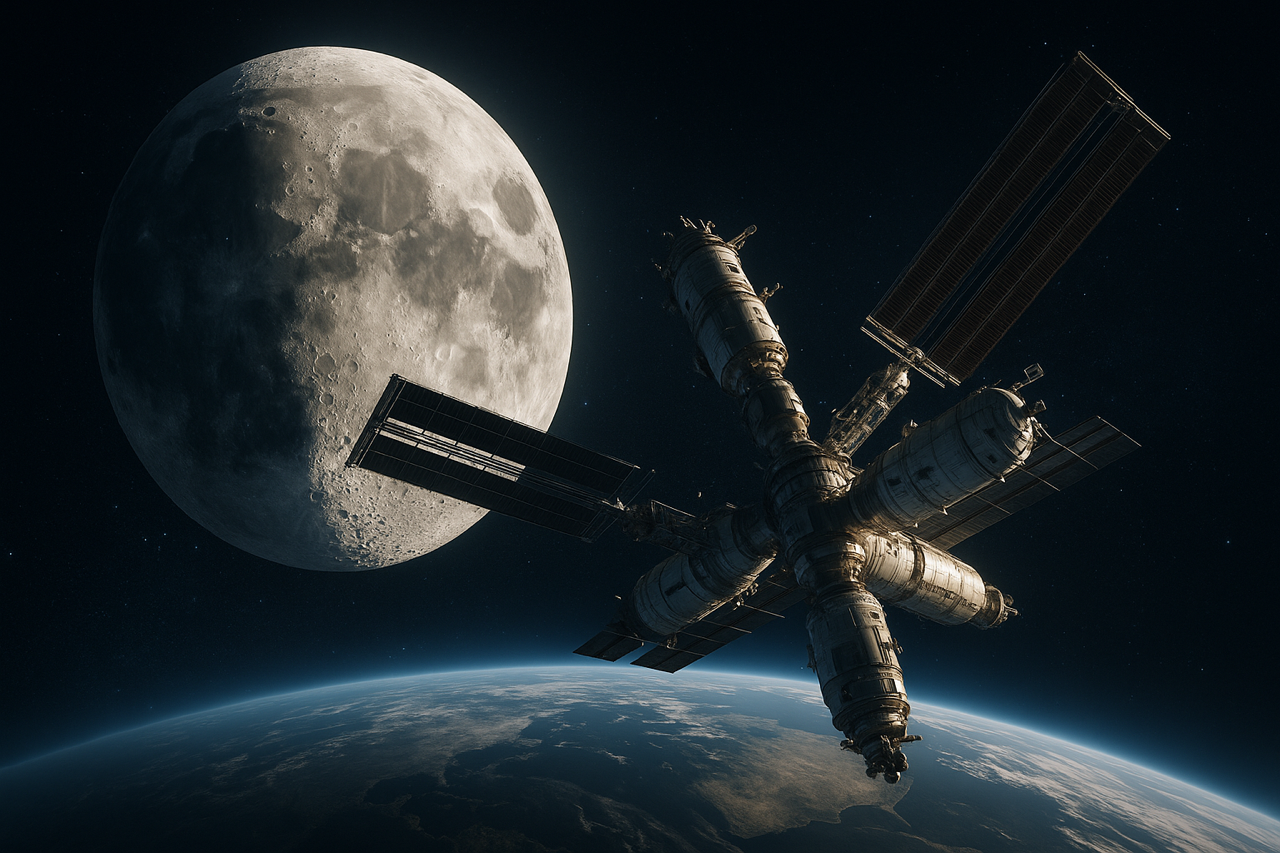
China is the main driver of this evolution. The Tiangong station, in orbit since 2021, was designed as a long-term modular platform and already hosts experiments in the fields of biology, medicine and materials science, which over the years have often been conducted with the help of many countries from different parts of the planet [17]. For its part, Russia, in addition to the recent announcement of a ten-year plan for the development of the space sector worth approximately $60 billion [18], intends to launch the Russian Orbital Station (ROS) by 2033 [19], with autonomous life support capabilities and docking facilities for new-generation vehicles [20]. The future presence of Tiangong and ROS would open up new scenarios, outlining a real “BRICS orbital system” [21] capable of competing, in terms of visibility and technological capacity, with the ISS, as it will be deorbited within a few years [22]. Beyond orbital stations, BRICS+ countries are consolidating their cooperation on satellite constellations. The 2021 agreement on the BRICS Remote Sensing Satellite Constellation has enabled the integration of members’ existing platforms, creating an Earth observation network covering the entire globe. In addition, the expansion of the constellation with satellites from countries that are very active in the space sector, such as the Emirates [23], Iran [24] and Egypt [25], would increase the frequency of image revisits and data resolution [26], with direct implications for natural resource management, climate monitoring and food security. This would also strengthen the group’s autonomy in strategic areas such as maritime surveillance and natural disaster prevention, reducing dependence on Western constellations such as Copernicus or Landsat. Alongside satellite capabilities, launch infrastructure is becoming a cornerstone of the BRICS+ space vision. The organisation of countries currently boasts nine orbital spaceports, including one in Brazil (Alcântara), one in India (Sriharikota), four in China (Xichang, Taiyuan, Jiuquan and Wenchang) and three in Russia (Baikonur [27], Vostočnyj and Plesetsk), which already provide a wide range of launch options at various latitudes [28]. Furthermore, the proposal to build spaceports in Indonesia [29] and Africa [30] would enable the group to construct an even more resilient network that is less exposed to political pressures or logistical disruptions. This infrastructure finds additional solidity in the availability of natural resources. Rare earths and other critical materials are indispensable for satellites, propulsion systems, and advanced technologies [31]. BRICS+ countries possess substantial domestic deposits [32], placing them in an advantageous position to secure supply chains, reduce vulnerability, and increase their weight within the global space economy. These resources also fuel a growing industrial ecosystem in which private actors play an increasingly important role. In India, for example, start-ups such as Skyroot Aerospace have already carried out autonomous launches [33], while in Brazil, companies operating in agricultural remote sensing are consolidating their position [34]. In China, private companies are actively involved in the creation of satellite constellations for telecommunications [35]. Furthermore, the new development plan for the Russian space programme [36] emphasises the importance of ever-greater collaboration between the public and private sectors, with a proposed constellation of satellites scheduled for launch by 2030, which will see a strong contribution from private actors [37]. The integration of these initiatives within the BRICS+ context could give rise to a large internal market, capable of attracting investment and promoting economies of scale. Complementing this industrial dynamism are technological frontiers that promise to reshape the group’s competitiveness. Russia has begun experiments in plasma propulsion for long space journeys [38], while South Africa has collaborated with China in the development of quantum communications [39]. Integrating these innovations into a shared network could significantly strengthen the group’s technological competitiveness. If technological advances broaden the group’s horizons, so too do its ambitions beyond Earth’s orbit. In 2021 China and Russia have signed preliminary agreements for the construction of the International Lunar Research Station (ILRS) [40], conceived as a cooperative platform intended to welcome, in the future, other members of the group and partners from the Global South [41]. In this context, Beijing has outlined a long-term strategy as part of a broader national space roadmap with a horizon of 2050, envisaging establishing a permanent presence on the lunar surface by 2045 [42]. Related projects also include a joint Russian Chinese proposal to build a power plant on the Moon, designed as an energy infrastructure capable of ensuring autonomy and operational continuity for future bases [43]. Other members of the bloc are also positioning themselves for a role in lunar exploration. Following the success of the Chandrayaan missions, India is aiming for a prominent role in joint programmes on the lunar surface, leveraging its experience in low-cost missions and strengthening its reputation as a technologically reliable partner [44]. The United Arab Emirates, already a key player with its Hope mission to Mars, intends to capitalise on the experience gained to enhance its credibility as a partner in lunar initiatives, offering contributions particularly in the development of robotic modules and scientific instruments [45]. These initiatives are taking place in a geopolitical context in which the Western alternative to the ILRS project, namely the Artemis Accords and the Lunar Gateway promoted by the United States and ESA, does not appear to be guaranteed as a stable priority. Uncertainties arising from policy changes in Washington, particularly following the election of Donald Trump and the rise of figures such as Elon Musk in the political arena, have contributed to raising doubts about the programme’s continuity in the short term [46]. These projects do not only serve scientific or industrial purposes: they also constitute powerful instruments of influence. By offering access to satellite data, Tiangong experiments, or future lunar missions to non-Western countries, BRICS+ could deploy “space diplomacy” [47] as an emblematic soft power tool, strengthening its identity as an alliance of the Global South and broadening its political reach [48]. This projection into international relations necessarily raises the issue of space governance. Until now, space governance has been shaped by rules that originated almost entirely in the Western context, such as the 1967 Outer Space Treaty or the more recent Artemis Accords. The BRICS+ bloc could instead aim to propose an alternative model, based on the principles of non-appropriation, peaceful use and equitable access to resources [49]. A multilateral treaty spearheaded by the bloc could attract broad support from the Global South, thereby reshaping the legal architecture of outer space. At the political level, this ambition is consistent with the vision articulated in the 2025 Rio Declaration, which formalized a commitment to governance based on equity, sustainability, and inclusiveness. Unlike NATO – and hence the G7 –, which in 2019 defined space as a domain of warfare [50], BRICS+ countries have advanced an alternative concept: space as a domain of cooperation and shared progress. Their trajectory is not intended to transfer terrestrial rivalries into orbit, but rather to foster a balance aligned with the multipolar configuration emerging in global geopolitics and economics.
Ultimately, these dynamics point toward the emergence of a new spatial order. Rather than a segregated arena of competition, space could become a point of convergence, reflecting a broader redistribution of global power. Within this framework, “astropolitics” emerges as the strategic field in which nations define their positions, while “extraterrestrial multipolarity” suggests the possible evolution of the international system–extended beyond Earth, yet still shaped by the political interactions and alliances forged on it.
BRICS+ space cooperation is now a privileged observatory for analysing the evolution of global multipolarism. In a domain long dominated by the United States and its allies, the bloc — in a relatively short time — has been able to chart a course which combines the established expertise of China, Russia and India with the new potential emerging from the global South. The importance of this path lies not only in the infrastructure built or the programmes announced, but above all in the ability to propose a more inclusive and balanced model of governance, in contrast to traditional Western and military logic. The Rio Declaration of 2025 clearly expresses the intention to project the economic and demographic weight of the group beyond Earth’s boundaries, laying the foundations for an autonomous and competitive space ecosystem. If consolidated, this process could foster the formation of a new space order, not geared towards the exclusion of other forms of cooperation, but based on principles of collaboration and shared prosperity. In this perspective, space no longer appears as a theatre of rivalry, but as an extension of a multipolar order that transcends the atmosphere, helping to redefine the rules of the future.
The BRICS International School: New Generation is the flagship educational and outreach project of the BRICS-Russia Expert Council, hosted by the National Research University Higher School of Economics (HSE University). It is based on one of the world’s most successful specially designed short-term training programs for developing specialists in the study of the BRICS intergovernmental association.
The project’s goal is to build a talent pool of young professionals from BRICS countries and BRICS partner states – the next generation of leaders. The project has been held annually since 2017 with the support of the Russian Ministry of Foreign Affairs.
[1] World Economic Forum (2024), “Space: The $1.8 Trillion Opportunity for Global Economic Growth Insight Report” (Link)
[2]CNSA (2024), “About China’s lunar mission: Timeline of Chang’e-6 mission”, (Link)
[3] Space.com (2023), “India on the moon! Chandrayaan-3 becomes 1st probe to land near lunar south pole”, (Link)
[4] European Space Policy Institute (2021), “Emerging Spacefaring Nations. Review of selected countries and considerations for Europe”, (Link)
[5] Klinger J.M., “A Brief History of Outer Space Cooperation Between Latin America and China” in Journal of Latin American Geography, Vol.17, No.2, July 2018, pp. 46-83.
[6] The cooperation continues today, as demonstrated by the july 2025’s announcement of the joint development of the CBERS-5 satellite.
Governo do Brasil, (2025), “Brasil e China anunciam desenvolvimento conjunto do satélite CBERS-5”, (Link)
[7] Ministry of External Affairs Government of India (2006), “List of Agreements signed during the visit of the Russian Prime Minister Mr. Mikhail Fradkov”, (Link)
[8] UNOOSA (2015), “Joint Statement of the delegations of BRICS States at the 58th session of the UN Committee on the Peaceful Uses of Outer Space on issues pertaining to the elaboration of the guidelines on long-term sustainability of outer space activities”, (Link)
[9] Ministry of External Affairs Government of India (2015), “VII BRICS Summit Ufa Declaration (Ufa, the Russian Federation, 9 July 2015)”, (Link)
[10] More specifically, the constellation comprises satellites such as CBERS-4, developed jointly by Brazil and China; Russia’s Kanopus-V series; India’s Resourcesat-2 and Resourcesat-2A; and China’s Gaofen-6 and Ziyuan III-02. The associated ground stations are in Cuiabá (Brazil), the Moscow Region (Russia), Shadnagar–Hyderabad (India), Sanya (China), and Hartebeesthoek (South Africa)
SANSA (2021), “BRICS Space Agencies leaders signed Agreement for cooperation in Remote sensing satellite data sharing”, (Link)
[11] CNSA (2022), “BRICS countries launch joint committee on space cooperation”, (Link)
[12] Ria Novosti (2025), “Лидеры стран БРИКС согласились на создание космического совета”, (Link)
[13] BRICS Brazil 2025 (2025), “Rio de Janeiro Declaration Strengthening Global South Cooperation for a More Inclusive and Sustainable Governance”, (Link)
[14] BRICS Brazil 2025 (2025), “Annex on Sustainable Space Connectivity Resources”
BRICS Brazil 2025 (2025), “Peaceful Exploration and Use of Outer Space — Issues Note”
[15] Statista (2025), “BRICS Plus and G7 countries’ share of the world’s total gross domestic product (GDP) in purchasing power parity (PPP) from 2000 to 2024”, (Link)
[16] World Population Review, “Total Population by Country 2025”, (Link)
[17] UNOOSA (2019), “United Nations/China Cooperation on the Utilization of the China Space Station (CSS). Selected Experiment Projects to be executed on board the CSS for the 1st Cycle”, (Link)
[18] Kommersant (2025), “Путин утвердил нацпроект «Космос» с бюджетом 4,4 трлн рублей до 2036 года”, (Link)
[19] TASS (2024), “Борисов утвердил генеральный график создания Российской орбитальной станции”, (Link)
[20] TASS (2024), “Роскосмос утвердил эскизный проект перспективной Российской орбитальной станции”, (Link)
[21] TASS (2023), “Россия предлагает странам БРИКС создать совместный научный модуль на РОС”, (Link)
[22] NASA (2024), “The International Space Station Transition Plan”, (Link)
[23] GMV (2025), “The UAE´s MBZ-SAT Earth Observation satellite successfully launched”, (Link)
[24] Mehr News Agency (2024), “Iran achieves ‘super resolution’ satellite imaging technology”, (Link)
[25] Space in Africa (2023), “Egypt Launches Earth Observation Satellite, Horus-1”, (Link)
[26] Kearney (2025) “Leapfrogging into orbit: how LEO can accelerate emerging nations’ space capability development”, (Link)
[27] Although it is located in Kazakhstan, which is in any case a partner country of the organisation, the Russian Federation has the right to utilise the cosmodrome until 2050.
[28] Launching space rockets from the equator is particularly advantageous because the Earth’s rotational speed reaches its maximum value in this region. This additional eastward speed gives the vehicle an initial boost as it reduces fuel requirements or, alternatively, allows for an increase in the payload that can be transported. Furthermore, proximity to the equator simplifies insertion into low-inclination orbits, which require less energy than more inclined ones.
NASA Science, “Chapter 14: Launch”, (Link)
[29] Gazeta.ru, (2024), “Россия поможет Индонезии при строительстве первого космодрома”, (Link)
[30] Space in Africa (2024), “Russia Offers to Build Spaceports in Africa”, (Link)
[31] SFA (Oxford), “Critical Minerals and Space Technologies”, (Link)
[32] Specifically, the BRICS+ countries hold 72% of global rare earth reserves on their soil.
CSIS (2023), “Six New BRICS: Implications for Energy Trade”, (Link)
[33] The Hindu (2022), “Vikram-S, India’s first private rocket, lifts off from ISRO spaceport”, (Link)
[34] Reuters (2024), “Satellite firm Visiona eyes growth as Brazil doubles down on aerospace”, (Link)
[35] Global Times (2025), “Chinese firm shows mobile-to-satellite communication technology”, (Link)
[36] See footnote 18
[37] Roscosmos (2025), “Юрий Борисов: в России стартует национальный проект по развитию многоспутниковой группировки”, (Link)
[38] Nauka Rosatom (2025), “Ученые «Росатома» завершили разработку прототипа плазменного ракетного двигателя для дальних космических полетов”, (Link)
[39] South China Morning Post (2025), “China creates hacker-proof quantum satellite communication link with South Africa”, (Link)
[40] MID (2022), “Соглашение Между Правительством Российской Федерации И Правительством Китайской Народной Республики О Сотрудничестве В Области Создания Международной Научной Лунной Станции”, (Link)
[41] Currently, eleven countries, in addition to Russia and China, have joined the project; yet, recent statements by Xi Jinping at the SCO summit in Tianjin suggest that further members will soon be added.
Minister of Foreign Affairs People’s Republic of China, “Pooling the Strength of the Shanghai Cooperation Organization to Improve Global Governance”, (Link)
[42] National Space Science Center (2024), “National Mid- and Long-term Plan for Space Science in China(2024-2050)”, (Link)
[43] Ria Novosti (2025), “Россия и Китай подписали меморандум о создании электростанции на Луне”, (Link)
[44] Reuters (2023), “Chandrayaan-3 punches home India’s lead in budget space flights”, (Link)
[45] Mohamed Bin Rashid Space Centre, “Emirates Airlock”, (Link)
[46] Financial Times (2025), “Europe’s Moon plans at risk as Trump team reviews Nasa’s Artemis project”, (Link)
Nature (2025), “US senators poised to reject Trump’s proposed massive science cuts”, (Link)
[47] The Diplomat (2025), “Reaching for the Stars: China’s Growing Space Diplomacy”, (Link)
[48] UNIDIR (2025), “The importance of space security for the Global South”, (Link)
[49] See footnotes 13 and 14
[50] NATO (2019), “London Declaration”, (Link)


