
Many industry representatives are already calling the India AI Impact Summit, which was held in mid-February, the starting point of a new era in global technology policy. The summit in Delhi was the fourth in a series of global forums, the first having been held in 2023 in the UK at Bletchley Park, followed by Seoul, South Korea, and Paris, France. The Summit was hosted by a country from the Global South for the first time. This meant not just a change of geography but a signal as to who will shape the rules for global technological development in the coming decades. BRICS Business Magazine tells how India is changing the global AI agenda.
The significance of the Indian summit follows on logically from the previous episodes. The first forum in the UK’s Bletchley Park three years ago focused primarily on the risks posed by AI development and the safety of its use. There was a palpable sense of caution in the face of a rapidly developing and still largely unexplored new technology. The Seoul forum in 2024 also, to a great extent, followed the same trajectory. In February 2025 in Paris, with India co-chairing alongside France, the agenda had already begun to shift towards practical application, which later became reflected in the name change, from the first AI Safety Summit to the AI Impact Summit in India. According to experts from the law firm Crowell & Moring, the change in the forum’s name reflects a shift in priorities: from safety and regulation to practical impact, deployment and measurable results.
Delhi completed this turnabout. “Impact” became the key word. The organizers responded
to the demand of the community, tired of theoretical discussions about existential risks, and gave the floor to those wanting to discuss how AI is already changing socio-political life, affecting all its facets, from healthcare and education to agriculture and space exploration.
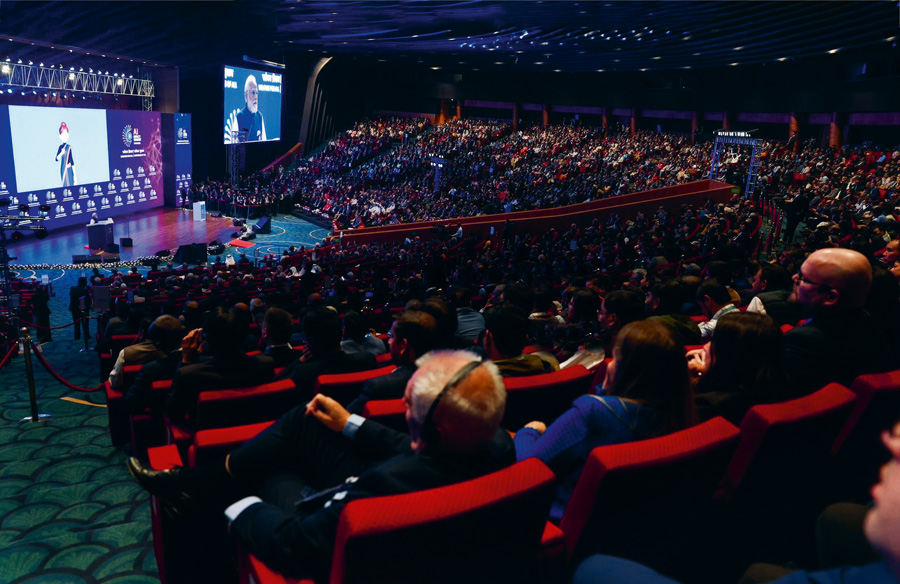
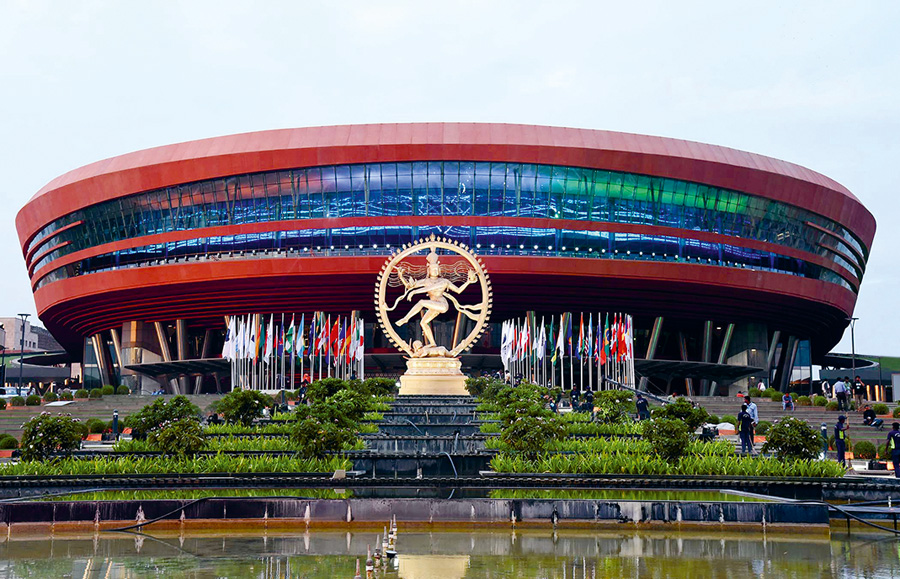
The Indian summit took place from 16 to 21 February 2026 at the Bharat Mandapam complex in New Delhi, gathering about 600,000 in-person participants and over 900,000 online stream views. International delegations represented more than 100 countries and 20 global organizations. The plenary session of heads of state on 19 February was attended by over 20 heads of state and government, as well as over 60 ministers. Among the participants from the technology industry were such significant figures as Sundar Pichai (Google), Sam Altman (OpenAI), Dario Amodei (Anthropic), Demis Hassabis (Google DeepMind), and Mukesh Ambani (Reliance Industries). The forum was opened by Indian Prime Minister Narendra Modi, with welcoming addresses from French President Emmanuel Macron and UN Secretary-General António Guterres.
The summit’s architecture was built around three fundamental principles or sutras: People, Planet, and Progress. Seven thematic working groups (chakras) covered issues ranging from economic growth and the social benefits of AI to democratization of computing resources, safe AI, science, and workforce reskilling. The entire format of the event was fundamentally practice-orientated; its goal not being the signing of yet another declaration of intent but emergence of specific commitments with measurable parameters.

The main diplomatic result of the summit was the Delhi Declaration on AI Impact. The document was signed by more than 90 countries and international organizations, so can be considered a major diplomatic success. Interestingly, India managed to secure support from both China and the United States, whereas, in 2025, the American side did not sign the Paris Declaration.
This significant result of shifting the focus from AI’s potential harm to its potential benefits created space for consensus where there had previously been fundamental disagreements, with the first three summits in the series gathering only 29, 11, and 60 signatories, respectively. Forum participants undertook several specific commitments, such as launching a special platform called the Global AI Impact Commons, showcasing over 80 examples of successful AI applications across numerous countries for sharing experiences and replicating best practices. The strategic achievements also include the signing of the Sustainable AI Guiding Principles (20+ countries); the Charter for Democratic Diffusion of AI (22 countries);
a network of AI science institutes (19 countries); and the release of a Guide to Fair Workforce Reskilling in partnership with the ILO (International Labour Organization).
Impressive figures were also announced on the investment front. Total commitments to investment in the AI infrastructure, foundation models and applications exceeded USD 200 billion.
The role of global AI summit host fell to India not by chance, as there was a certain diplomatic logic to it. Back in Paris in February 2025, Modi called for the global AI partnership to be made more representative in terms of the priorities and challenges of the Global South and announced an Indian initiative to create its own large language model, taking into account the country’s linguistic diversity. At the same time, India consistently positioned itself as a bridge between the technologically developed economies of the West and the developing world. This mediating narrative opened up space for potential consensus between Washington and Beijing.
Furthermore, in the AI field, India has significant economic ambitions. It is no coincidence that, in recent years, India has led the world in the AI specialist hiring rate and is among the top countries in the concentration of AI skills.
A country with a population of over a billion people, a vast array of diverse data, a mature engineering school and developed digital infrastructure objectively claims the role of not just a consumer but also an architect of global AI standards.
In March 2024, the Government of India approved an AI Mission with a billion-dollar, five-year budget and a call to “Make AI in India and make AI work for India”. The programme covers seven main areas: computing infrastructure, development of sovereign large language models, datasets, education, startup financing, responsible AI, and international partnerships. An unprecedented amount of funds and resources have been allocated for the mission. A separate priority of India’s state AI strategy is to create a sovereign language model. A country with 22 constitutionally recognized languages and hundreds of regional dialects cannot afford to depend exclusively on English-language Western AI systems. As a result, on the sidelines of the summit, the Sarvam AI startup presented
a new generation of language models with unique sovereign parameters.
The outcome of state involvement in AI development is that, in 2025, India’s AI technology sector projected revenues of about EUR 280 billion, and about 89% of the new startups launched in 2024 are already using AI in their products or services.
The Global South narrative promoted by India at all levels of the February summit and India’s potential as an effective mediator are particularly valuable for BRICS partners that have their own interests in developing and implementing AI within the scope of international standards. Ahead lies joint work on ethical principles, data exchange for training neural networks, mutual recognition of diplomas for Data Science specialists, and other partnership initiatives that were actively discussed at the summit by representatives of the public sector and business.
For the first time in the four years of global AI negotiations, a country that is neither part of the Western camp nor the US–China technological duel took on the role of moderator and achieved
a consensus unprecedented in scope. For the BRICS association, this is not just good news, it is a signal of a new opportunity architecture. The next AI series summit will take place in Geneva in 2027. The question that experts will be asking in the meantime is: Will the broad coalition assembled
in Delhi be able to transform itself into sustainable coordination mechanisms, rather than remain just another set of voluntary declarations?


