
In March 2026, China launched its first automated humanoid robot production line. A factory in Guangdong Province produces a humanoid every 30 minutes, having an annual production capacity of 10,000 units. This marks the end of a pilot project in the field of anthropomorphic robotics. Enterprises worldwide, including in BRICS countries, are now seeking the optimal business model for commercial production of humanoid robots. We analyze the key trends shaping the industry, the sector’s main growth points and technological barriers, as well as the state of humanoid robot production in Russia.

Until very recently, humanoid robots were perceived more as an experimental development with the primary task of entertaining technology park visitors and garnering likes on social media. Just recall the techno-optimistic videos from Boston Dynamics, which trained their robots to dance and perform somersaults almost better than live acrobats. Yet, as the technology develops, more and more market participants see humanoids not as a spectacular show but as a tool for resolving numerous problems in the real economy, from cutting production costs across various industries to compensating for labour shortages.
Research company Global Market Insights forecasts that the global humanoid robot market will grow from USD 4.6 billion in 2023 to USD 74 billion by 2032, meaning an average annual growth rate of approximately 37%. According to the Humanoid Robot Research study by Counterpoint Research, approximately 16,000 new humanoid robots were installed worldwide in 2025, while their numbers will reach 100,000 units by 2027. According to a Morgan Stanley forecast, by the middle of the 21st century, the market volume will reach USD 5 trillion, and the number of humanoid robots deployed in various spheres will exceed 1 billion.

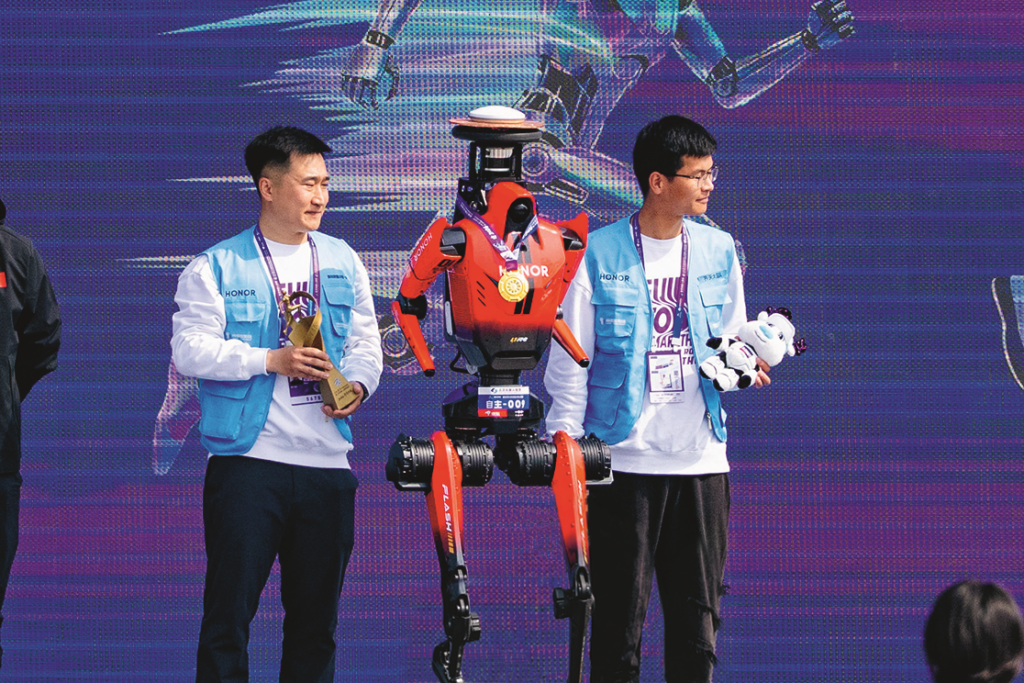
Today, China is the undoubted development leader in this field. Chinese humanoid robots are already being used in industrial enterprises, for freight packaging, in the service sector and HoReCa, as well as in the social sphere and medicine. Analysts at Counterpoint Research note that China accounted for over 80% of all installations in 2025. Four of the five biggest suppliers of humanoid robots, which captured 73% of the market last year, are Chinese companies: AgiBot, Unitree Robotics, Ubtech Robotics, and Leju (Shenzhen) Robotics. The fifth company is the American company Tesla, which made it into the ranking by launching production of Optimus humanoid robots.
In addition to China, there are also projects in the humanoid robot field in other BRICS countries. For example, in India, Vyommitra, a humanoid robot for space flights, has been developed.
A series of unmanned test flights are currently under way, and the first manned space missions with Vyommitra are scheduled for 2027.
Last year, in Russia, the Association for the Production of Humanoid Robots New Technological Coalition (NTC), which unites several leading development companies in this field, presented the anthropomorphic robot Aidol including AI. It is capable of performing a variety of tasks depending on the settings, so it can be used both in manufacturing and for service tasks. In addition, in March this year, IT Imperial presented the first Russian humanoid robot controllable using VR glasses. It is assumed the robot will perform the functions of an anthropomorphic assistant and will also be used in the service sector, at exhibitions and various events.
Analysts at Counterpoint Research note that, over the next two years, an increasing number of enterprises developing humanoid robots will begin commercializing serial versions. There are several key drivers boosting the development of this industry.
First and foremost is the development of AI. “Now, both the hardware and AI have reached a level where anthropomorphic robots can demonstrate potential new applicability in real-world scenarios”, explains Alexey Yuzhakov, leader of the New Technological Coalition, founder and chairman of the Promobot board of directors. “Components (actuators, sensors, processors, batteries) have become sufficiently mature and affordable for assembling robust solutions. And AI has become powerful enough for the robot to understand context and act more naturally and usefully in a real environment, rather than just by rigid scripts.”
At the same time, as noted by Alexey Bogdanov, Product Director at Robotics Corporation, the current development of LLMs has peaked largely because they are trained using synthesized data, texts, and images. The next level of AI development is AGI (Artificial General Intelligence), a type of AI capable of understanding, learning, and applying knowledge to solve a wide range of problems at a level comparable to or surpassing human capability. “This is only possible if AI acquires physical bodies to gain experience interacting with the physical world”, notes Alexey Bogdanov.

Another reason for the interest in anthropomorphic robotics is a social one. “From the perspective of the current global birth rate, introduction of robots is becoming critically necessary”, believes Alexey Bogdanov. He says that, in 1950, the average global birth rate per woman was five children. This indicator has now fallen to 2.2 children. “When the indicator drops to 2.1, we will cross the population growth line and begin to lose it. Unless we introduce such a technology, there will soon be no one left to work.” Japanese, Korean, and German factories are already unable to fill shifts, adds Ildar Sattarov, General Director of the Alliance of Advanced Technologies. He forecasts that, by 2030,, the personnel shortage in global industry could reach eight million people.
Alisa Konyukhovskaya, an expert on the Russian robotics market and a business consultant on robotization, notes that the great attention paid to the humanoid robot segment in China is no coincidence. “China has a demographic hole that they essentially dug themselves by promoting the ‘one family, one child’ policy for decades. The state is well aware that the labour shortage will only increase by the year. At the same time, someone will need to serve the rapidly aging generation. Support for humanoid robotics in China is not just a technological race, it is a strategic response to social and economic challenges.”
For investors ready to pour hundreds of millions of dollars into the humanoid robot industry, this is a chance to enter the last major sector that has not yet been automated, believes Ildar Sattarov. “Software automated information, CNC machines automated individual operations. The humanoid robot is an attempt to automate universal physical labour”, notes the expert. According to McKinsey, venture financing for robotics more than trebled from 2023 to 2025, reaching USD 40.7 billion a year. As Andrey Dren, Executive Director of ESTUN, emphasizes, a potentially new “iPhone moment” is currently opening up for investors, though for the physical world: if a robot appears that actually performs a wide range of useful tasks, this could be a market worth tens of billions, or even more.
The advantage of humanoids over other types of robot lies in them being trainable to perform the same work as a human. “For thousands of years, we have adapted our environment to make it convenient for humans; consequently, a machine that resembles a human externally will be the most efficient”, Alexey Bogdanov emphasizes.
Currently, humanoid robots are used most often in two industries: the automotive industry and industrial logistics, says Ildar Sattarov. The choice of these particular spheres, according to Andrey Dren, is due to them involving comprehensible operations, a predictable environment, and high downtime costs, so it is easier to calculate the economics. For example, throughout 2025, Figure AI conducted an experiment in collaboration with BMW: industrial robots Figure 02 were installed at the plant in Spartanburg (USA), working alongside people. During this period, the humanoids participated in producing over 30,000 BMW X3 vehicles. Ubtech deployed Walker S1 robots at the Zeekr plant, while Mercedes-Benz uses Apollo robots from Apptronik at its European plants. Regarding logistics, there are pilot projects with humanoids at, for example, Amazon and GXO. Industrial service and maintenance, as Andrey Dren says, can also be handed over to humanoid robots: they can perform inspections, simple routine actions, and work for long periods in uncomfortable positions where it might be difficult or dangerous for a human.
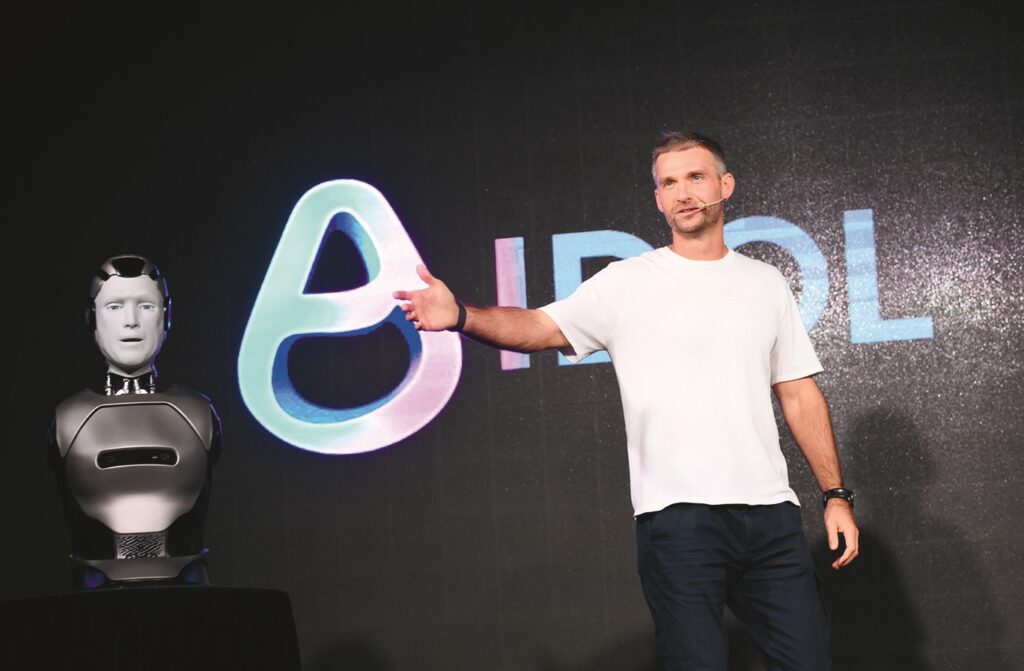
Humanoid robots also excel at communication functions with large flows of people: consultations, navigation, routing requests in public spaces, and so on. For example, according to Vladimir Vitukhin, General Director of Aidol Company, the Russian humanoid Aidol is already being used precisely in such scenarios. One example is the Gulfood 2026 exhibition in Dubai, where Aidol worked on reception, greeted guests, and answered visitors’ questions in a multilingual mode.

Other areas where humanoid robots could potentially be applied include retail (delivery, packaging), HoReCa (cleaning during hours closed to visitors), and medicine (assisting medical staff, basic patient care).
In the future, according to Alisa Konyukhovskaya, use of humanoids by households as universal helpers could constitute a large market. For example, the Norwegian startup 1X last year introduced the NEO domestic humanoid robot, which can assume part of the household routine: folding laundry, cleaning rooms, moving objects, and cooking. Yet, according to Konyukhovskaya, mass integration into people’s daily lives will definitely not happen in the next few years, as this will require advanced software, a solution to safety issues, and legal formalization. “Most likely, we will not see a humanoid ready for operation immediately after purchase ‘out of the box’, like a computer or smartphone, anytime soon”, the expert believes.
Further development of humanoid robots faces several barriers that experts and market participants have yet to overcome.
One of the key barriers is energy. A humanoid robot consumes a lot of energy to move through space and perform various manipulations. At the same time, a robot balancing on two legs can only afford an eighth of its mass for the battery, otherwise, the centre of gravity is disturbed, says Ildar Sattarov. As a result, the current autonomous operation limit for humanoids averages only 2–4 hours. A possible solution in production processes could be a quick battery swap.
The high cost of robots is also an obstacle to mass adoption in various industries. “Now, according to Morgan Stanley estimates, the current production costs of humanoid robots can range from USD 10,000 to USD 300,000 per unit, depending on the configurations and requirements for their application in subsequent processes”, cites Evgeny Sumarokov, Associate Professor of the Department of International Business at the Financial University under the Government of the Russian Federation. Conventional robots currently used in industry are much cheaper. True, experts note that, with the launch of serial production of humanoids, the cost will fall owing economies of scale.
The high cost problem can also be partially resolved by the Robot-as-a-Service (RaaS) model, allowing the customer to lease rather than buy the robot. Such a scheme is offered to clients by, for example, Aidol. “We are developing a Robot-as-a-Service (RaaS) model so that, for the customer, the entry point is not a ‘hardware purchase’ but an operational model with service and obligations. According to our calculations, with a correctly chosen scenario, the payback period for one robot could be 2–3 years, primarily owing to reduced payroll costs”, said Vladimir Vitukhin.
One of the most underestimated barriers, according to Ildar Sattarov, is safety. If a humanoid robot loses its balance for some reason, 50–70 kg of metal and plastic could fall on anyone standing nearby. So far, there are no standards or certificates for humanoids. “We are building a car, though the traffic rules haven’t been written yet”, the expert emphasizes. Alisa Konyukhovskaya also notes the cybersecurity risks: humanoid robots are capable of gathering much more information about the surrounding space than ordinary devices. So, the issue of data protection and hacker attack prevention immediately arises.
The first leaders are already emerging on the humanoid robot market. At the forefront of the industry is China, which has effectively turned this field into a large-scale national project. Chinese authorities have announced accelerated development and implementation of humanoid robots within the 15th Five-Year Plan for 2026–2030. According to McKinsey, China has allocated USD 138 billion state venture capital for developing AI, robotics, and related industries. A Robot Valley is operating in Shenzhen, accommodating 15 leading robotics companies with municipal fund support. Beijing is ready to provide subsidies of up to CNY 100 million for pilot testing centres in the robotics field. In terms of the number of patent applications mentioning humanoids, China surpasses the United States more than three-fold, Evgeny Sumarokov cited data. “China is building a production chain capable of producing thousands of units of stable quality. By this criterion, it is ahead today, and it will be extremely difficult to compensate for its advantage”, notes Ildar Sattarov.
The United States leads in terms of AI and capital markets. OpenAI, Google, Anthropic, Nvidia, and Tesla set the standards in the field of large language models, computer vision, and computing power, without which modern humanoid intelligence is impossible. The US venture market annually pours tens of billions of dollars into robotics startups, allowing them to advance quickly from a laboratory prototype to a commercial sample.
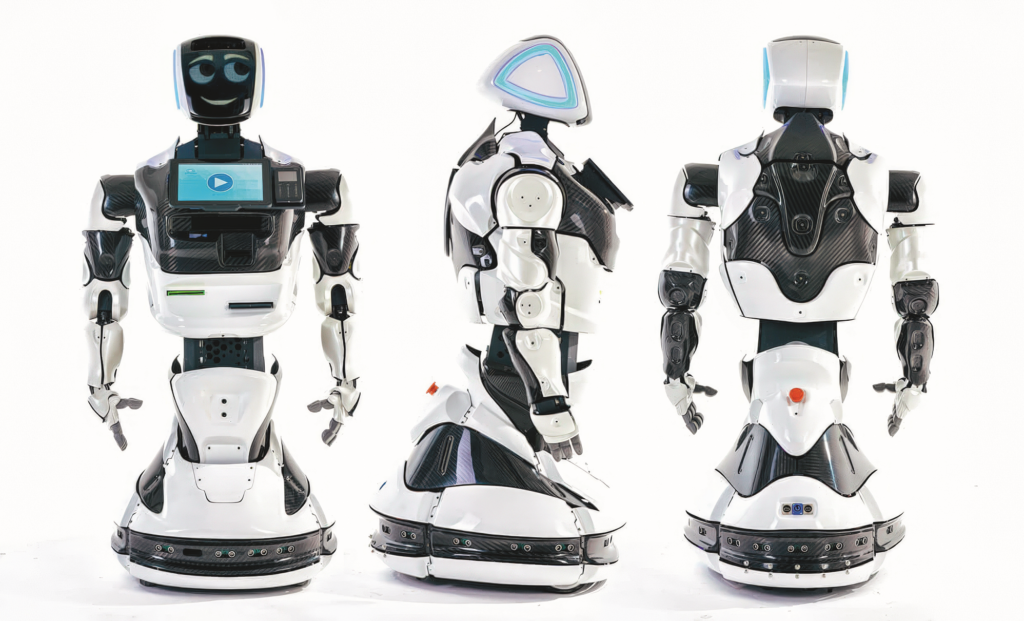
Among Russia’s advantages are a strong engineering school and competencies in complex systems, notes Alexey Yuzhakov. Even so, for a truly strong field to emerge, it is not enough just to develop a robot: cooperation in competencies and flexibility, which corporations lack, for example, is needed. This is precisely why the New Technological Coalition (NTC) was established as an association of participants including Promobot, Aidol, Double U Expo, and technical universities. The goal, according to Alexey Yuzhakov, is to build a universal anthropomorphic platform in Russia, brought to serial production, a service model, and safe operation.
Vladimir Vitukhin notes that further development of humanoid robots in Russia is constrained by the component base and scaling of production and service. “Speaking specifically about Aidol, 77% of the robot’s components are today produced in Russia, and we understand how to increase the localization level to 93% when we enter into serial production”, the expert states.
At the same time, Russia suffers acutely from absence of the same systematic approach as China. Currently, development of humanoid robots in Russia is based on initiatives by individual companies, says Alisa Konyukhovskaya. Yet, this is a fairly capital-intensive industry requiring large-scale investment, which only the state and big companies are capable of. Only state support and anchor customers can provide long-term pilots and financing for product maturity (otherwise, it is difficult for startups to survive until serial production), adds Andrey Dren. In addition, of course, Russia needs a strong software environment: if the hardware is partially imported, competitiveness can be built on control, perception, integration, safety, and simulation (i. e., on brains and the ecosystem).
Ildar Sattarov believes that it is now pointless and impossible for Russia to try to catch up with the leaders. The country has many limitations: a lack of computing power, the outflow of IT specialists abroad since 2022, broken supply chains due to sanctions, and expensive capital. So, what is needed is not a broad state programme attempting to “catch up with everyone on all fronts” but a targeted focus on three or four specific niches, with a clear path to a result. For example, 80% of Russian gas is extracted in conditions where human labour is difficult, expensive, and dangerous, such as in the Arctic. Russia could concentrate its efforts in this direction by developing humanoid robots specifically for use under extreme conditions. Here, Russia is solving a problem that does not exist on such a scale in other countries, this giving it a chance to assume a leading position in this niche.


