
The United Aircraft Corporation and BRICS Business Magazine present the legendary
and innovative models of civilian airliners.
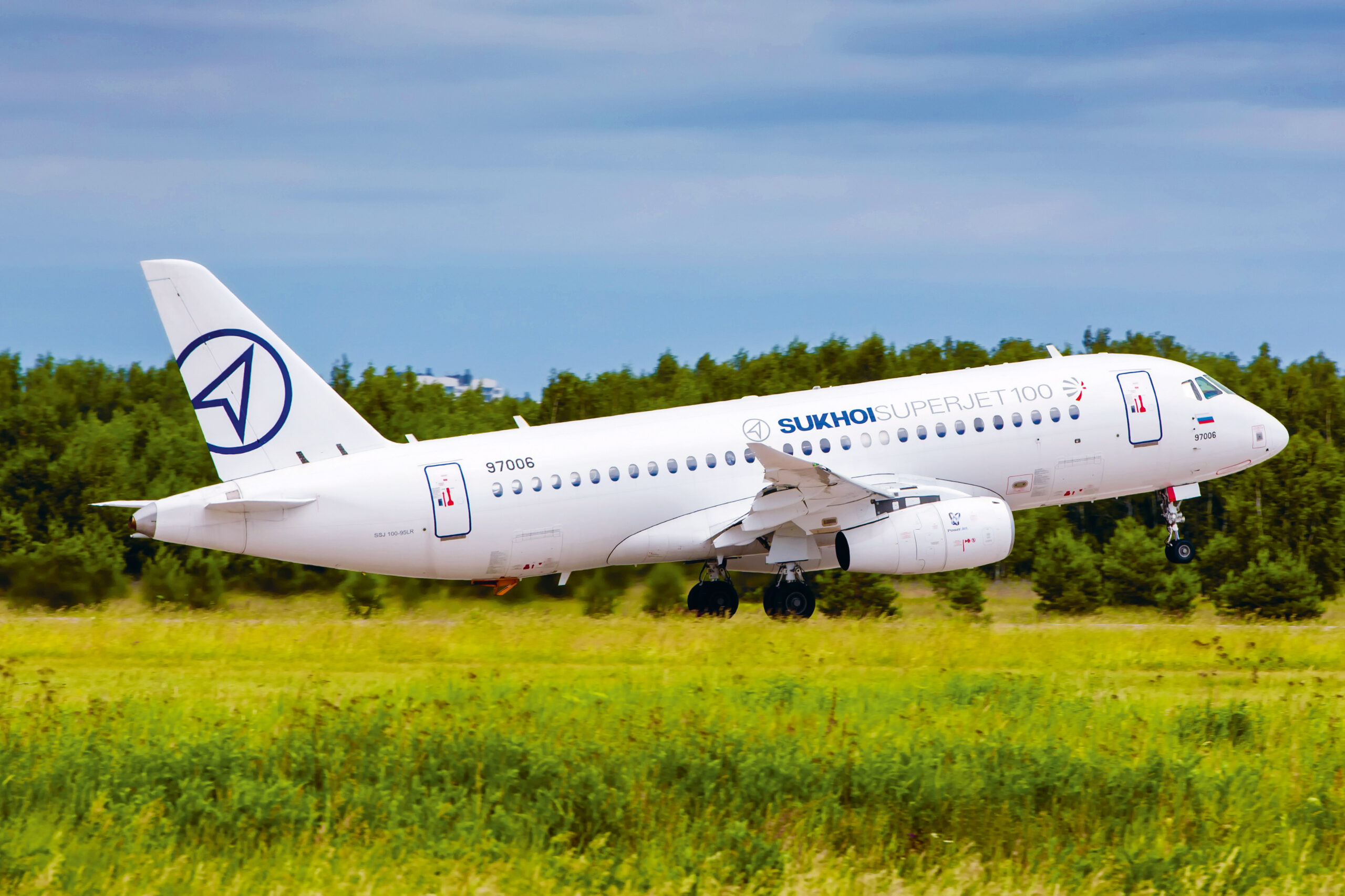
The Superjet 100 (SSJ100) is a new generation aircraft developed and manufactured by Sukhoi Civil Aircraft. It has been created using the newest technologies in the field of aerodynamics, thrust systems, and avionics, ensuring efficiency of operation and comfort for passengers. The SSJ100 is designed for transportation on short-haul and medium-haul routes. The aircraft was first introduced to the public in September 2007. As of August 2018, there are 133 SSJ100 aircraft in operation by Russian airlines and government agencies: Aeroflot, Gazpromavia, Yakutia, Yamal, IrAero, Azimut, MOI of Russia, EMERCOM, SOS Russia, RusJet, as well as in other countries: Interjet (Mexico), CityJet (Ireland), and the Royal Air Force of Thailand. In total, the aircraft have already carried out more than 300,000 commercial flights lasting over 460,000 flight hours.
To create a new domestic regional aircraft – the SSJ100 – the JSC Komsomolsk-on-Amur branch of Sukhoi Civil Aircraft (JSC KNAF GCC) was formed in the Russian Far East in 2005. As early as 2007, the first test SSJ100 aircraft was introduced to the public, and a year later, it performed its maiden flight. Thus, only five years had passed from the moment the production was set up to the commercial manufacturing of the aircraft. Today, the Komsomolsk-on-Amur branch comprises: Technocomplex, the distribution center of components for the production sites of the branch; the fuselage assembly shop (FAS); the final assembly department (FAD) of the aircraft; and the flight-test center (FTC). At the final assembly department, work is carried out at seven production sites at the same time – five at the fuselage assembly shop, while two sections of the flight-test center perform ground checks of the built aircraft.
Russian leadership calls the program of creating new airliners the main priority in civil aviation. The key to the program’s execution is Irkut Corporation (part of the United Aircraft Corporation), which is striving to create a competitive aircraft for the largest segment of the Russian and global aviation market. Advanced solutions are employed to ensure the superiority of MS-21 over its competitors in two key areas: economic efficiency and comfort.
The series’ basic aircraft, the MS-21-300, is designed to carry 16 passengers in business class and 147 in economy. In a tight single-class arrangement, the aircraft will be equipped with 211 seats.
Aircraft designers managed to increase the MS-21’s aerodynamic efficiency index by five to six percent in comparison with the existing Western aircraft. The main contribution to the improvement of aerodynamics is made by a unique highly elongated wing. Since a metal wing with the required characteristics cannot be built, it was decided to use the newest polymer-composite materials.
The advanced engines contribute significantly to reducing fuel consumption. The MS-21-300 is being tested with Pratt & Whitney PW1431G engines. In parallel, Russia is creating a new PD-14 engine, which has similar characteristics. The choice of the type of engine for serial production of the aircraft remains with the customer.
The results of the first tests show that the creators of MS-21 would be able to achieve their goal: to reduce the operating costs by five to seven percent compared to the most modern types of other narrow-body aircraft.
The diameter of the MS-21 fuselage is 30 cm larger than that of the Boeing B737 and 11 cm larger than that of the Airbus A320 and the Chinese C919.
This makes it possible to significantly improve the comfort of passengers, especially on long-distance routes, where narrow-bodied airplanes are increasingly being used. Clients can order the MS-21 with wider seats or choose an arrangement with a wider aisle. In the latter configuration, passengers would be able to pass by a service trolley in the aisle.
A wide fuselage will speed up the landing and disembarkation of passengers. Kirill Budaev, vice president of Irkut Corp., notes, “Each arm shows a saving of five to seven minutes. With an average of 1,500 flights a year, this gives the airline an additional 150 hours, which can be used for flights.”
Certification tests of the first two aircraft of the MS-21-300 family are being conducted in the Flight Research Institute near Moscow. Test aircraft fly there from the manufacturing center in Irkutsk, covering over 4,000 km.
According to Vice President for AT Development — Director of Engineering Center at Irkut and Chief Designer of the MS-21 Konstantin Popovich, the tests so far confirm the effectiveness of the aircraft’s key design and production solutions.
At present, Irkut has firm contracts for 175 aircraft. Among the first operators of the aircraft is the national carrier of Russia, Aeroflot, which ordered 50 MS-21s that are scheduled for delivery from 2020 to 2026.
Russian and Chinese aircraft builders, represented by PJSC United Aircraft Corporation and China Corporation of Civil Aviation, are working together to build a new generation of wide-body long-haul aircraft: the CR929. This is the most high-tech project in the countries’ portfolio of common partner projects.
PJSC UAC and COMAC shared investment and time risks, combining intellectual, technological, and other resources to create the CR929 aircraft in a very competitive market.
Broad-bodied aircraft occupy a special place in the global civil aviation market. In quantitative terms, the global share of wide-body aircraft is less than 20% of the number of civil aircraft of all types. However, the total market value of all wide-body aircraft is more than 50% of the market value of all types of civil aircraft.
According to the forecast of UAC-COMAC, in 2023-2045, global demand for wide-body long-haul aircraft will reach 7,200 units. Of these, the markets of the two partners will account for 20% of the total demand – 15% in China and five percent in Russia. Some 28% will be accounted for in other countries in the Asia-Pacific region. The CR929 program will rely on the home markets of the participating countries of the project as the starting point.
The main requirements that the new generation wide-body long-haul aircraft CR929 should meet were formulated by the partners – PJSC UAC and COMAC – based on interviews with airlines and leasing companies. Those requirements were improved economic efficiency of operation, improved fuel efficiency, improved aircraft maintenance, and guaranteed flight performance, as well as solid takeoff and landing characteristics.
“The key task of the design unit is to ensure the competitiveness of the CR929. Due to the smaller take-off weight, we expect to translate that into fuel savings. Optimal technical solutions will increase the operational characteristics and will offer significant economic benefits to carriers, while the passengers will enjoy improved comfort thanks to the industrial design of the cabin,” says Maxim Litvinov, chief designer on the Russian side, talking about the advantages of the CR929 aircraft compared to its competitors.
At the moment, the CR929 program is in the Gate 3 stage. The main objectives of this stage are to sketch the design and to begin the procedure for selecting suppliers. During this stage, requirements for aircraft systems will be finalized, experimental and research work in aerodynamics will be carried out, and materials will be selected.
Production cooperation will be decided on, and a system of after-sales service and a sales strategy will be developed. As a result of this work, the final shape of the CR929 aircraft will be finalized, and the business plan for the program will be refined.
The Gate 3 stage is intended to be completed in mid-2019.


