Who is the contemporary African artist? They are often someone educated in Europe or America and even having grown up outside their historical homeland. This makes contemporary African art very international. Artists no longer bring their “Negritude” to the fore as they did in the 1950s–1960s, the era of independence movements. While remaining proud of their cultural roots, they assert their claim for international recognition on a par with their Western culture colleagues. This is a very important turn for overcoming the colonial optic and eradicating inequality within the global art market.
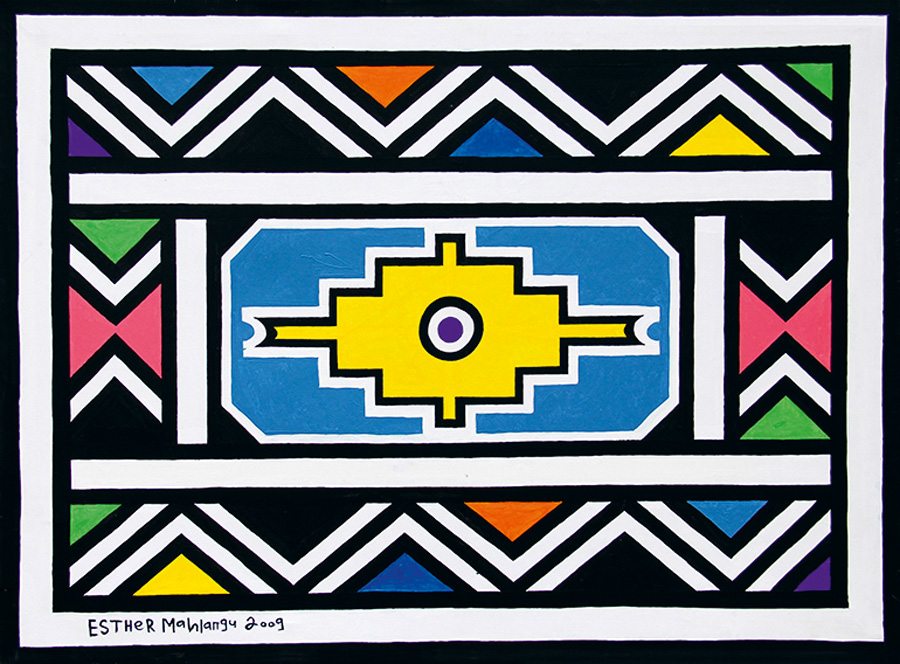
Born in 1935 in Mpumalanga Province, South Africa, Esther Mahlangu is the world’s most famous representative of Ndebele culture. At an early age, she became acquainted with the technique of mural painting. Gradually, she began to transfer images onto canvas, creating large-scale paintings that refer to the heritage of the Ndebele tribe and its traditional ornaments. Sometimes, the artist experiments with fluorescent vinyl paints or returns to muted, earthy colors. At the invitation of Jean-Hubert Martin, Mahlangu participated in the Paris exhibition Magiciens de la Terre and has also successfully exhibited in Australia, America, Japan, many European countries, and Russia. Works by Esther Mahlangu were featured in the project Reverse Safari at the Manege in St. Petersburg in 2023.
Mali’s capital Bamako is a recognized centre of African photography. This is the achievement of the famous 1960s photographer Malick Sidibé, who died in 2016. Mali’s independence from France ushered in an era of rapid social and cultural change, which Sidibé, nicknamed the “Eye of Bamako”, captured. His photographs show the bustling night city, dandies strolling in ultra-fashionable suits and dark glasses or daringly racing on motorcycles, challenging the established perception of suffering and poverty of the African people. The works of Malick Sidibé could be seen this year in Moscow at the exhibition Dandies. A Celebration Every Day at the Béton Centre of Visual Culture, alongside photographs by Congolese photographer Baudouin Mouanda, who picked up a camera at the age of 13 and subsequently documented the life of his native Brazzaville for local newspapers, earning the nickname “Photouin.”

A photographer from Nigeria, formerly a correspondent for The Guardian, The New York Times, USA Today, and CNN. Thanks to being granted access to the palaces and throne rooms of his native country, George Osodi managed to realize a large-scale project with ethnographic nuances called Nigerian Monarchs. In 1963, Nigerian kings lost their constitutional power, and a president became the head of the country. Yet, Osodi’s elegant photographic images clearly confirmed that the former rulers of states and kingdoms had not lost their grandeur and magnificence.

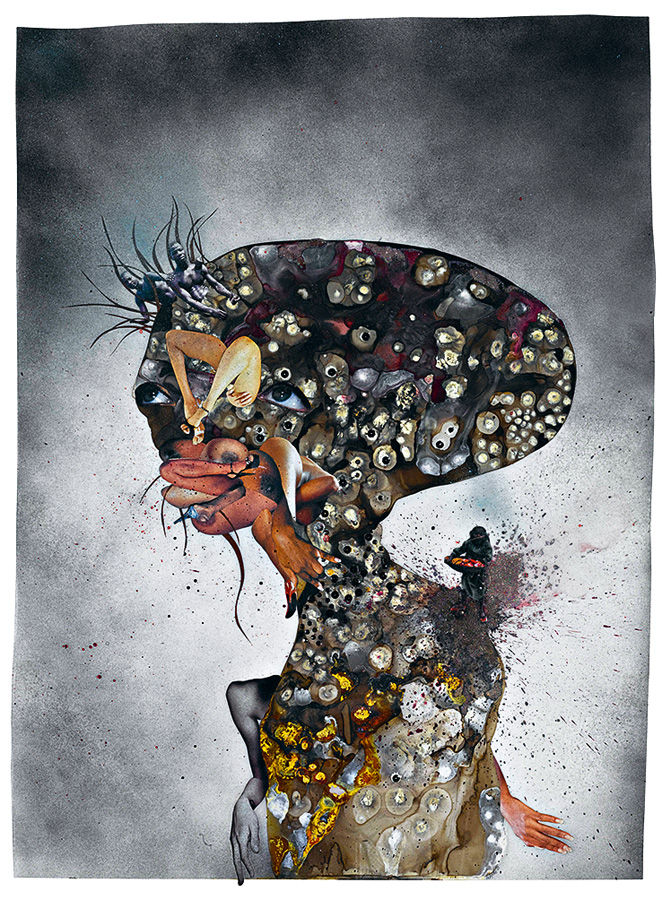
Images taken from magazines, painted surfaces, various random materials, even rubbish are all used in the works of Kenyan artist Wangechi Mutu, who studied sculpture and anthropology in the United States. In her socially charged collages, the artist raises acute issues of female identity and the cultural self-sufficiency of postcolonial Africa. In 2013, Mutu participated in the main project of the 5th Moscow Biennale of Contemporary Art.
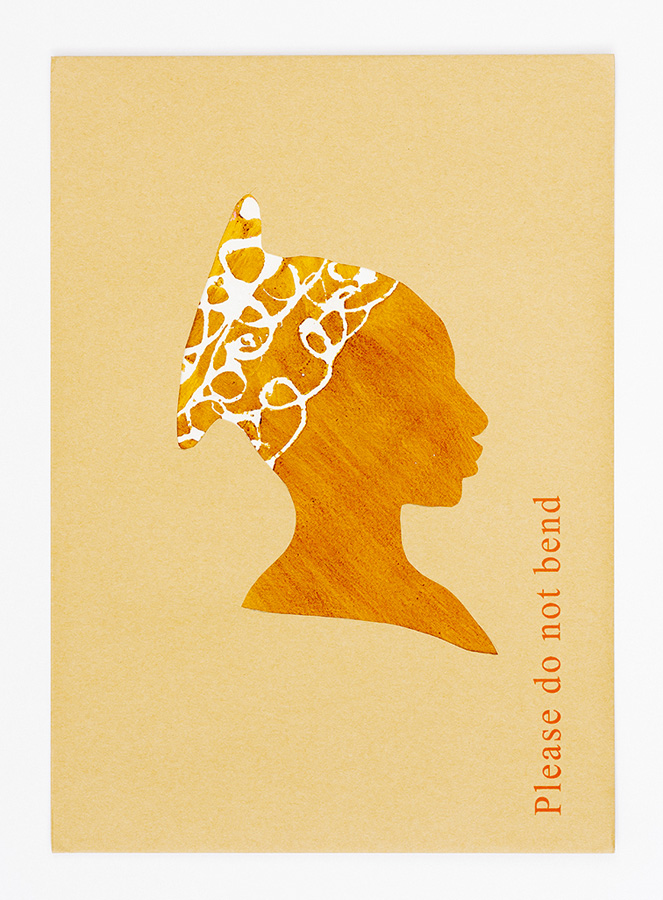
A contemporary artist from Nigeria, she was educated in Great Britain, where she now lives. Using silhouettes hand-cut from soft brown kraft paper, Evans celebrates African traditions and the ancient legends of her native land, employing her own background. Patterns subtly woven into the dynamic composition are very important in her spatial installations.

The Nigerian photographer Okhai Ojeikere, who died 11 years ago, whose works are held in the Metropolitan Museum of Art and Tate, became famous for his series Headwear. Throughout his life, he photographed the astonishing hair constructions and hairstyles of Nigerian women. “His formal language is instantly recognizable: the absence of backgrounds and any props, elegant models, intricate hairstyles, soft lighting, impeccable black-and-white printing. Ojeikere’s photography captured a moment of creativity reflecting the social and cultural life of Nigeria”, wrote his fellow art historians.

A young artist from Côte d’Ivoire, Laetitia Ky creates works using her own curly hair, artificial extensions, metal wire, and wax. Ky’s sculptures include, for example, animal heads, a television, a telephone, and flowers.

This Egyptian artist is a star of the international art scene. He participates in major contemporary art exhibitions such as Manifesta, Documenta, and the 50th Venice Biennale. Wael Shawky’s work is shown by the Serpentine Gallery in London. His works are held by the Tate Modern and the Museum of Modern Art (MoMA) in New York. The artist was born in Alexandria, studied in America, but prefers to work with the experience of all humanity. In his videos, performances, drawings, and photographs, Shawky explores world history, addressing aspects of religion, globalization, and culture. One of Wael’s most famous works is the video Cabaret Crusades.

From childhood, Marlene Dumas, a native of South Africa, copied random photographs from newspapers and magazines, transferring them into albums. Her expressive and provocative portraits and figurative works, based on Polaroid snapshots, brought fame to the artist, who moved from Africa to the Netherlands in 1976. The apocalypticism of Viennese Expressionism and the slightly blurred manner of Gerhard Richter’s paintings nourish Dumas’s work, whose painting is dedicated to death, love, and religion.


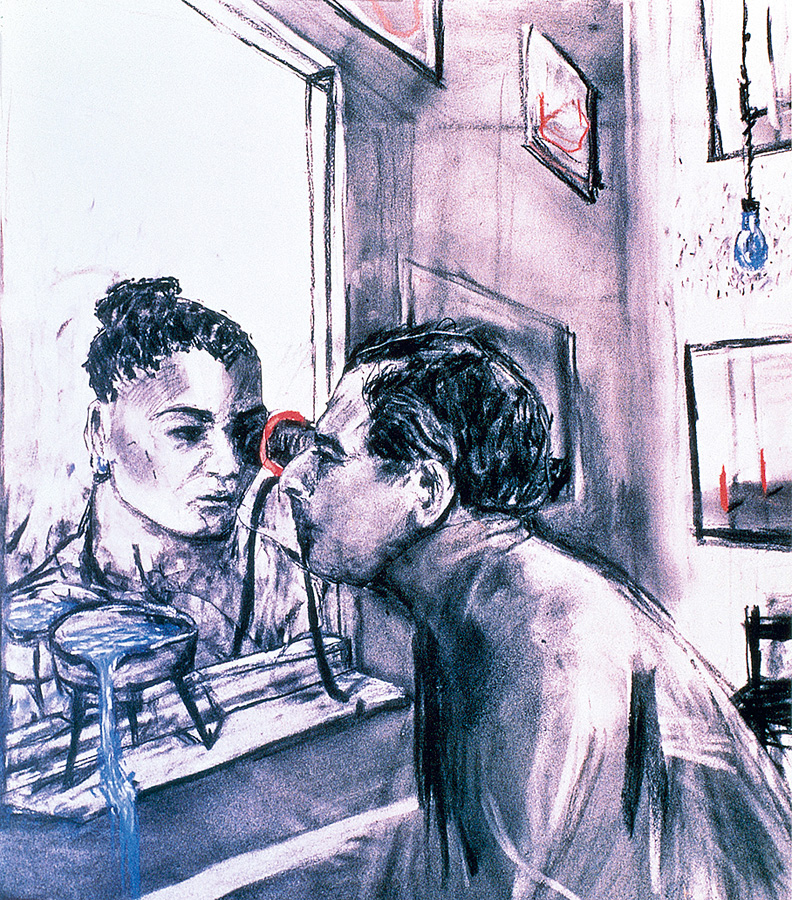
A large body of the work of the South African artist William Kentridge, his series of hand-drawn animated films, posters, and graphic cycles, forms a critique of South African apartheid in the late 1970s and 1980s. For example, the series Felix in Exile, created in 1994 just before the African National Congress elections, constitutes a recollection of the violent rules of apartheid and the struggle against it.